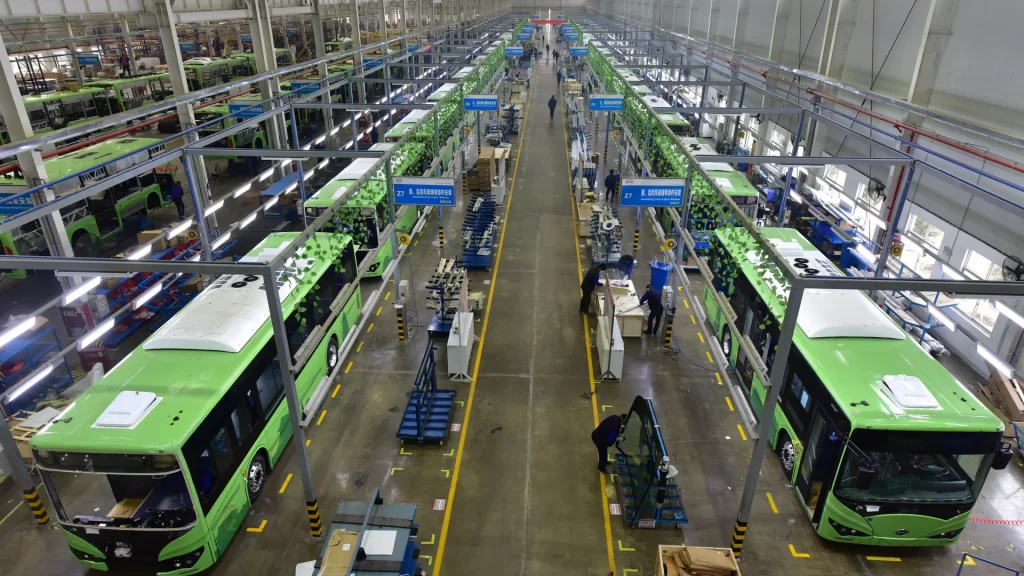
The Ministry of Trade and Industry (MINICOM) has unveiled plans to attract investors into establishing local assembly plants for electric vehicles, with a particular focus on electric buses, as part of efforts to strengthen domestic manufacturing and accelerate the country’s transition to green mobility.
Minister of Trade and Industry Prudence Sebahizi said the initiative is aimed at encouraging investment in local electric vehicle assembly, noting that expanding electric public transport will require domestic production capacity to meet rising demand.
He made the remarks while presenting key elements of the 10-year industrial policy (2024–2034) to Parliament.
Sebahizi told lawmakers that Rwanda’s push for electric mobility, especially in public transport, will only be sustainable if supported by local assembly and manufacturing systems.
The plan aligns with government measures requiring public institutions to ensure that at least 30% of newly procured vehicles are electric, a policy designed to accelerate adoption and stimulate market demand.
Officials say the broader strategy is intended to reduce reliance on imported fuel, stabilize transport costs, and support Rwanda’s climate commitment of cutting greenhouse gas emissions by 38% by 2030.
Rwanda has already seen steady growth in electric mobility, particularly in urban transport systems in Kigali, where electric buses are gradually being introduced.
Between 2021 and 2023, more than 2,000 buses were imported annually, reflecting rising demand in the public transport sector.
By 2024, the country had 512 fully electric vehicles and 7,172 hybrid vehicles, although these figures exclude electric buses currently in operation.
Lawmakers also called for stronger performance of existing local industries to reduce import dependence, arguing that improving domestic production would lower costs for government and consumers.
The 10-year industrial policy is aligned with the National Strategy for Transformation (NST2), which prioritizes industrial development as a key driver of economic growth.
Currently, Rwanda’s industrial sector operates at about 57% capacity, a level lawmakers say needs to improve to enhance productivity and efficiency.