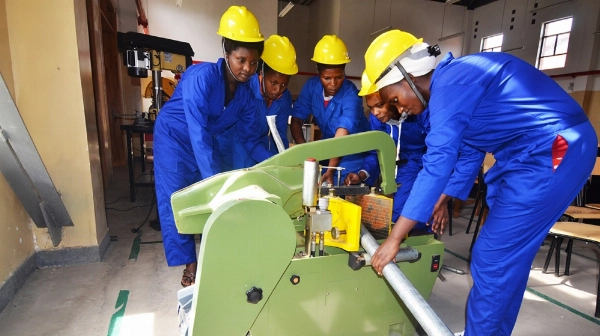
Employment among Technical and Vocational Education and Training (TVET) graduates in Rwanda has risen by 9.9 percentage points over five years, according to National Institute of Statistics of Rwanda, highlighting the growing impact of skills-based education on the labour market.
The report shows that the share of TVET graduates securing jobs increased from 58.2% in 2021 to 68% in 2025, consistently outpacing graduates from general education streams. In comparison, general education graduates’ employment grew from 39.7% in 2021 to 52.4% in 2025.
Yearly data reveal fluctuations: TVET employment rose to 63.8% in 2022, dipped slightly to 62% in 2023, then climbed to 67.2% in 2024 and 68% in 2025. General education graduates saw steadier but slower growth, reaching 41.4% in 2022 and 50.5% in 2024.
NISR attributes this trend to the practical skills TVET graduates acquire, which allow them to enter the workforce quickly, often in service or industrial sectors, while university graduates frequently face longer job searches. TVET skills also boost opportunities for self-employment, as graduates can create their own jobs rather than relying solely on formal employment.
Key sectors driving employment for TVET graduates include construction, electrical works, mechanics, and industrial technology, which continue to absorb the largest share of skilled workers compared with traditional office roles.
The report by the Ministry of Education for the 2024/2025 academic year shows TVET enrolment from Level 1 to Level 5 rose by 15.6%, reaching 135,025 students, though female participation remains low.
Under the second National Strategy for Transformation (NST2), the government aims for 60% of upper secondary school graduates to pursue TVET pathways, addressing youth unemployment and strengthening the skills pipeline for Rwanda’s labour market.
Mu #Rwanda, imibare y'Ubushakashatsi ku Bakora n'Abashomeri igaragaza ko abarangije amasomo ya tekinike, imyuga n'ubumenyi ngiro aribo bagira amahirwe yo kugira akazi kurusha abarangije amasomo y'uburezi rusange.
— National Institute of Statistics of Rwanda (@statisticsRW) April 2, 2026
🚨 Kuri wowe ubona biterwa n'iki? pic.twitter.com/iCcJSJlqgv