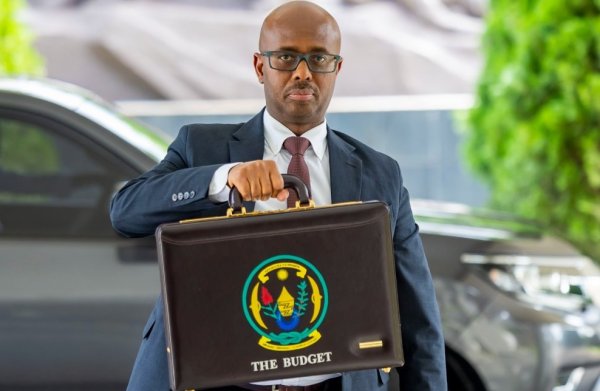
The Rwandan government has allocated 38.7% of its proposed Rwf7.796 trillion budget for the 2026/27 fiscal year to development projects aimed at accelerating economic growth, improving livelihoods and strengthening public services.
The budget framework was presented to Parliament on Monday, May 11, 2026, by Finance and Economic Planning Minister Yusuf Murangwa.
Out of the total budget, Rwf3.017 trillion will finance development and public investment projects, while Rwf4.779 trillion will cover recurrent expenditure, including salaries, government operations, equipment and public services.
According to the draft budget, Rwanda expects to finance most of the expenditure through domestic revenues projected at Rwf5.273 trillion.
Tax revenues are expected to contribute Rwf4.429 trillion, while non-tax revenues are projected at Rwf582.4 billion. The government also plans to generate Rwf123.6 billion through the sale of public assets.
Foreign grants are projected at Rwf548.3 billion, while external loans are expected to reach Rwf1.974 trillion.
The proposed allocations show that the City of Kigali will receive more than Rwf274.3 billion, while the Eastern Province is expected to receive the largest provincial allocation at Rwf278.1 billion.
The Southern Province has been allocated Rwf253.5 billion, the Western Province Rwf225.2 billion and the Northern Province Rwf198.6 billion.
During discussions on the budget, the Ministry of Local Government (MINALOC) told lawmakers that although implementation of the 2025/26 budget was generally satisfactory, some districts remained behind in budget execution.
Among the districts highlighted were Musanze District with an execution rate of 64.7%, Nyamasheke District at 65.06% and Nyamagabe District at 68%.
The Ministry of Finance said the 2026/27–2028/29 budget framework is aligned with Rwanda’s Vision 2050 agenda and the National Strategy for Transformation (NST2).
In the economic sector, the government plans to use the budget to accelerate inclusive growth in agriculture, industry and services, strengthen climate resilience, boost local manufacturing and increase exports in a bid to narrow the trade deficit and create sustainable jobs.
In the social sector, spending will focus on improving the quality of education, expanding healthcare services, strengthening nutrition and early childhood development programmes to reduce stunting, and supporting vulnerable households to escape poverty.
The governance pillar will prioritize improving service delivery, strengthening public finance management, promoting justice and citizen participation, safeguarding peace and security, and deepening international cooperation.
The proposed budget represents an increase of Rwf844.2 billion compared to the revised Rwf6.952 trillion budget for the 2025/26 fiscal year.