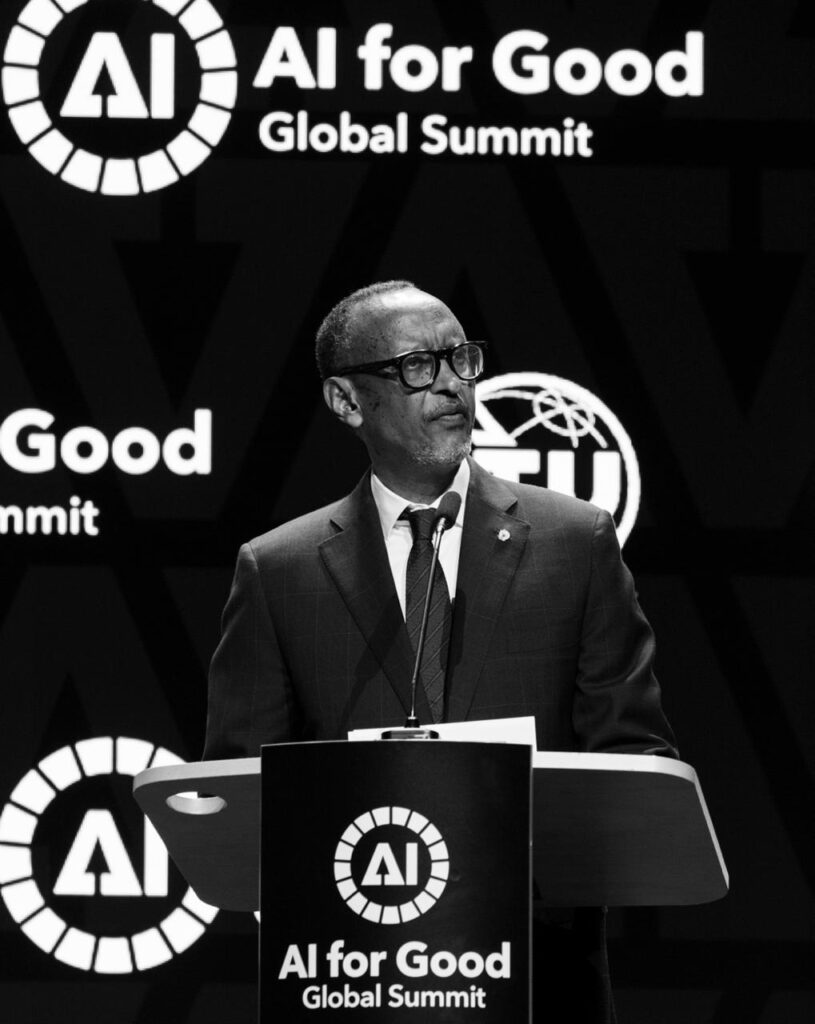
President Paul Kagame has urged Africa to seize the artificial intelligence (AI) revolution by becoming a creator of cutting-edge technologies rather than remaining a consumer, warning that the transformative potential of AI will only be realized through sustained investment, collaboration and inclusive digital infrastructure.
Speaking at the AI for Good Global Summit 2026 in Geneva on Wednesday, Kagame said AI presents an unprecedented opportunity to improve lives, boost economic growth and accelerate sustainable development, provided countries build the right foundations to support innovation.
The summit, held under the theme “Harnessing AI for Humanity,” was jointly organized by the International Telecommunication Union (ITU) and the Swiss government, bringing together world leaders, technology executives, policymakers and researchers to discuss the future of artificial intelligence.
Kagame said Africa is uniquely positioned to become a major force in the global AI ecosystem thanks to its rapidly growing and youthful population.
“By 2050, Africa will have the world’s largest workforce, and that number will continue to rise. We must invest in our young people and give them the opportunity to innovate and lead,” he said.
He stressed that the continent’s ambition should extend beyond adopting technologies developed elsewhere.
“Africa is no longer content with simply consuming technologies built by others. We want to create them, develop them and deploy them at scale,” Kagame said.
The President cautioned that intensifying geopolitical and economic competition among major powers risks turning advanced technologies into instruments of rivalry rather than drivers of shared prosperity.
Instead, he said, AI should remain focused on solving real-world challenges, improving livelihoods and advancing human development.
Building the foundations for AI
Kagame identified three priorities that countries must address to unlock AI’s full potential: expanding computing capacity, extending reliable internet connectivity and ensuring access to affordable, dependable electricity.
He said achieving these objectives will require stronger partnerships between governments and the private sector, alongside increased investment in digital infrastructure.
“Investing in artificial intelligence is an investment in our future and in future generations,” Kagame said.
With AI evolving at an extraordinary pace, he warned that countries cannot afford to delay preparations or underinvest in the technology.
He concluded by emphasizing that ambitious visions alone are not enough.
“What matters is not only having a vision but implementing it in ways that deliver tangible results,” he said.
Global cooperation essential
ITU Secretary-General Doreen Bogdan-Martin said the newly launched global AI commission builds on the achievements of the Broadband Commission, established 16 years ago to expand digital connectivity worldwide.
She noted that the Broadband Commission helped redefine high-speed internet as more than infrastructure, positioning it as a catalyst for economic growth, innovation and improved quality of life.
According to Bogdan-Martin, the emergence of AI demands a similarly coordinated global effort, bringing together governments, businesses, international organizations and civil society to ensure the technology serves humanity responsibly.
Salesforce founder and CEO Marc Benioff described AI as a transformational technology with the potential to reshape society even more profoundly than the internet or social media.
He called for open dialogue among governments, technology companies and global institutions to ensure AI is developed responsibly and benefits everyone.
“Technology itself is neither good nor bad. What matters is how we choose to use it,” Benioff said.
He added that the new commission is designed not to regulate AI but to provide a platform for dialogue, collaboration and practical solutions that promote the responsible development and use of artificial intelligence worldwide.