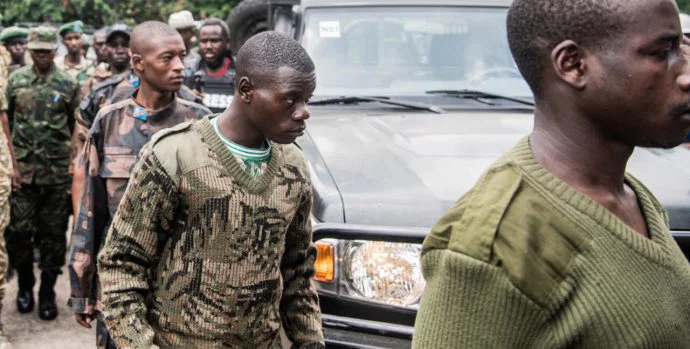
The Democratic Republic of the Congo (DRC) says it is seeking an African country to receive some FDLR fighters who refuse to return to Rwanda, as Kinshasa moves ahead with a plan to disarm and demobilise the armed group.
DRC Minister of Regional Integration Floribert Anzuluni disclosed the plan in an interview with RFI, following an agreement Kinshasa says it reached with FDLR leaders in late July.
Anzuluni said the latest initiative differs from previous attempts because both the political and military leadership of the FDLR agreed to the principles of disarmament and demobilisation.
He said Victor Byiringiro, who leads the FDLR’s political wing, FOKA, signed the agreement, while Gen. Ntawunguka Pacifique, also known as “Omega”, who commands the group’s military wing, and other FDLR leaders endorsed the plan.
“The political and military leaders clearly agreed to the principles contained in the programme for disarming and demobilising them,” Anzuluni said.
Kinshasa says an action plan, timetable and budget have already been prepared, although the details have not yet been made public because they remain subject to approval.
Anzuluni said implementation is expected to begin soon, with the objective of permanently resolving the FDLR issue.
The fate of fighters who refuse to return to Rwanda remains one of the most difficult issues in the process.
Anzuluni said the DRC has identified an African country willing to receive some of the fighters but declined to disclose its name. He said discussions with the country are ongoing and that its identity would be announced at an appropriate time.
Under the proposed arrangement, fighters willing to return to Rwanda would be repatriated, while those who refuse could be relocated to one or more other countries.
“Those who believe they can return to Rwanda will go back there. Those who do not want to return will have the opportunity to be relocated to one or more countries,” Anzuluni said.
Uncertainty over FDLR numbers
Kinshasa also acknowledges that it does not have a definitive figure for the number of FDLR fighters who would be subject to disarmament.
Estimates have varied widely, with figures ranging from several thousand to more than 20,000.
Anzuluni said the disarmament process would help authorities establish the actual number of fighters, register them and determine their locations.
“Today, we could say there are 500. Rwandans could say 10,000, while others could say 5,000. What matters is that this programme will enable us to identify all the fighters,” he said.
A United Nations experts’ report released in late June 2026 said the FDLR claimed to have more than 10,000 fighters, while its armed wing claimed to have more than 20,000. The experts, however, estimated the group’s actual strength at between 3,500 and 4,500 fighters.
The development comes amid efforts to implement the Washington peace agreement between Rwanda and the DRC, which includes provisions requiring action against the FDLR.
Rwanda’s Foreign Minister Olivier Nduhungirehe has previously criticised the separate Kinshasa-FDLR agreement, arguing that it could delay implementation of the Washington agreement.
Nduhungirehe has maintained that the Washington agreement already provides a framework for addressing the FDLR issue, including the dismantling of the group and the demobilisation and reintegration of its fighters.
The FDLR’s continued presence in eastern DRC has remained a major security and diplomatic issue between Kigali and Kinshasa, with the group’s future now emerging as a key test of the two countries’ commitments to the peace process.