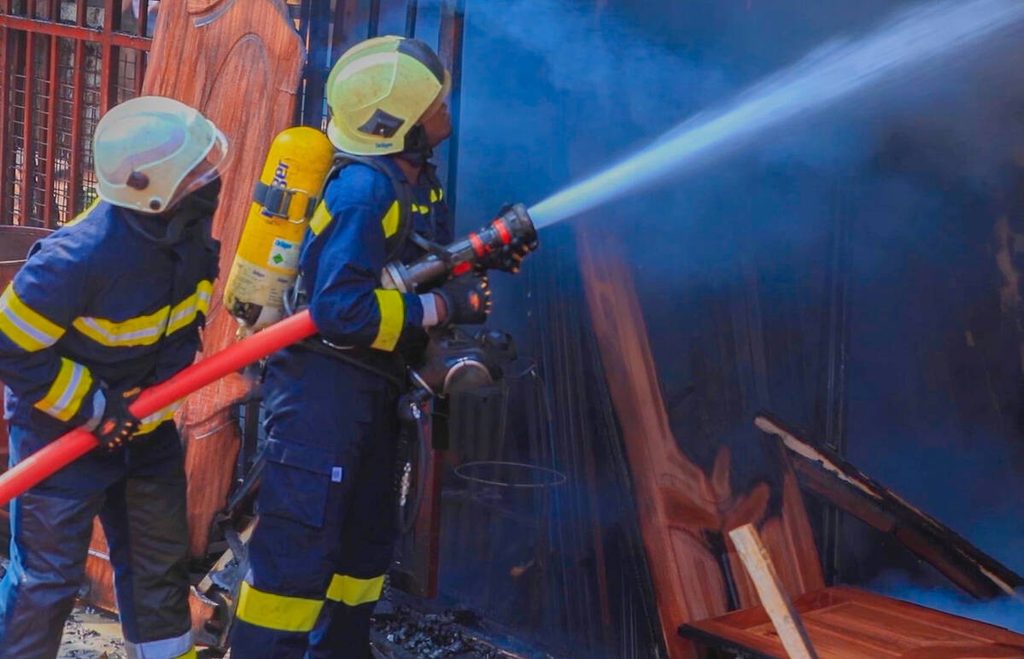
Fire outbreaks remain a major threat to lives and property in Rwanda, with some incidents resulting in deaths, permanent injuries and significant financial losses.
Despite this, some residents hesitate to call the Rwanda National Police for emergency assistance because they believe they will have to pay for the service.
The Police Fire and Rescue Brigade says its firefighting and rescue services are provided to the public free of charge and is urging residents to call for help as soon as a fire starts rather than attempting to contain it on their own until it grows beyond their control.
The message was emphasised on Tuesday, September 15, 2026, when officers from the Fire and Rescue Brigade in Rubavu District met residents and urged them to strengthen measures to prevent fires, particularly those caused by gas.
The meeting also provided an opportunity to address what officers described as a widespread misconception that residents must pay before a fire engine can be dispatched.
IP Kayisire, an officer with the brigade, said some residents believe they must pay more than Rwf300,000 before a fire engine can respond.
“That makes them call us only after they have spent a long time fighting the fire themselves. It is a serious problem because by the time we arrive, they may have already lost a lot of property,” he said.
Kayisire urged residents to disregard such claims and contact the brigade immediately when they encounter a fire emergency.
“Let me reassure you and ask you to tell others: this is a service that the Government of Rwanda has brought closer to citizens. It is a free service provided by the Rwanda National Police,” he said.
“We are here to rescue Rwandans. Anyone who told you that this service must be paid for was giving you wrong information. That idea should be put aside.”
He said the brigade’s mandate extends beyond firefighting to include a range of emergency rescue operations.
“We are responsible for firefighting and other rescue operations, including rescuing people who have fallen into pits, people trapped in vehicles after accidents and other emergency situations,” he said.
How the Fire and Rescue Brigade operates
The Rwanda National Police was established under Law No. 9/2000 of June 16, 2000. Various specialised units were subsequently established, including the Fire and Rescue Brigade, which was tasked with preventing fires and similar disasters from causing deaths, injuries and damage to property.
The brigade is responsible for preventing and fighting fires, rescuing people affected by different disasters and educating communities on fire prevention and emergency response.
It also trains residents in the use of firefighting equipment, inspects public and private buildings, advises property owners on appropriate fire-safety equipment and investigates the causes of fires.
From two fire engines to 27
When the Fire and Rescue Brigade was established, it had limited resources and operated with only two fire engines to cover emergencies across the country.
At the time, fires frequently resulted in deaths and extensive property damage, while the limited number of vehicles made it difficult for firefighters to reach incidents across the country quickly.
More than 25 years later, the brigade has expanded its fleet to 27 fire engines, with vehicles deployed across all provinces and the City of Kigali. Some locations have more than one vehicle, while additional fire engines are stationed at Police headquarters.
ACP Paul Gatambira, head of the Fire and Rescue Brigade, said the growth of the unit reflects the broader development of the country and the Rwanda National Police.
“As the years have gone by, the country has developed, and the Rwanda National Police has also developed. The Fire and Rescue Brigade has grown as well, from having just two vehicles to 27,” Gatambira said.
The brigade has also acquired a range of firefighting and rescue equipment, including portable fire extinguishers, blankets, dry-powder equipment and other specialised tools.
“Currently, we operate across all provinces and the City of Kigali. Our plan is to reach every district and deploy fire engines and other rescue equipment there,” Gatambira said.
Where fire engines are stationed
Some of the brigade’s vehicles are equipped to fight fires in high-rise buildings and rescue people trapped in tall structures. The vehicles are stationed at strategic locations around the country to improve emergency response.
In Kigali, one fire engine is stationed at the Kigali City Police headquarters, another at the Kigali City Tower (UTC), while an additional vehicle is based in the Masoro industrial area.
The Eastern Province has three fire engines, stationed in Rwamagana, Nyagatare town and Rusumo in Kirehe District.
The Western Province has two, one in Rubavu and another in Rusizi.
In the Southern Province, fire engines are stationed in Muhanga and Nyanza, while the Northern Province has one in Musanze.
Additional fire engines are stationed at Rwanda National Police headquarters in Kacyiru and can be deployed to support teams elsewhere when major fires occur.
Police says response can take less than 10 minutes
Some residents have expressed concerns about delays in emergency response. Police officials, however, say the perception can partly be influenced by the fear and panic experienced by people witnessing a fire, who may expect responders to arrive immediately after making a call.
Police says fire engines stationed in Kigali can generally reach fire scenes within five to 10 minutes.
In the provinces, response times depend on the location of the incident and road conditions. When a fire occurs in a remote area or in a location with difficult roads, responders may take between 40 minutes and one hour to arrive.
Five main types of fires
The Fire and Rescue Brigade identifies five main categories of fires: those involving solid materials, flammable liquids, gases, metals and electrical equipment.
Police records show that 1,118 fire incidents linked to these categories were recorded between 2020 and 2024.
There were 136 incidents in 2020, 123 in 2021, 238 in 2022, 259 in 2023 and 362 in 2024.
Police is urging residents to follow fire-safety advice and avoid careless actions or using equipment they do not understand, noting that many fires can be prevented.
Residents are advised not to leave candles or matches within children’s reach, to ensure gas appliances are properly switched off and to avoid leaving electrical equipment plugged in unnecessarily.
They are also advised to avoid using substandard electrical equipment and to ensure that electrical work is carried out by people with the necessary knowledge and skills.
Police further cautions residents against keeping gas cylinders and petroleum products in living spaces. People using gas are advised to inspect the cylinder, hose and ignition system before lighting it and to ensure that rooms are properly ventilated.
Residents are encouraged to keep portable fire extinguishers, gas-leak detectors and appropriate fire blankets where possible. They are also advised to avoid using damaged or faulty electrical equipment.
People who have received fire-safety training are encouraged to act quickly when a fire starts, but not to put themselves at risk, and to call the Fire and Rescue Brigade immediately.
The brigade says early reporting can make a critical difference, giving firefighters more time to contain a fire before it spreads and causes greater loss of life and property. Most importantly, residents should not delay calling for emergency assistance because of fears about the cost: the firefighting and rescue service is provided free of charge.