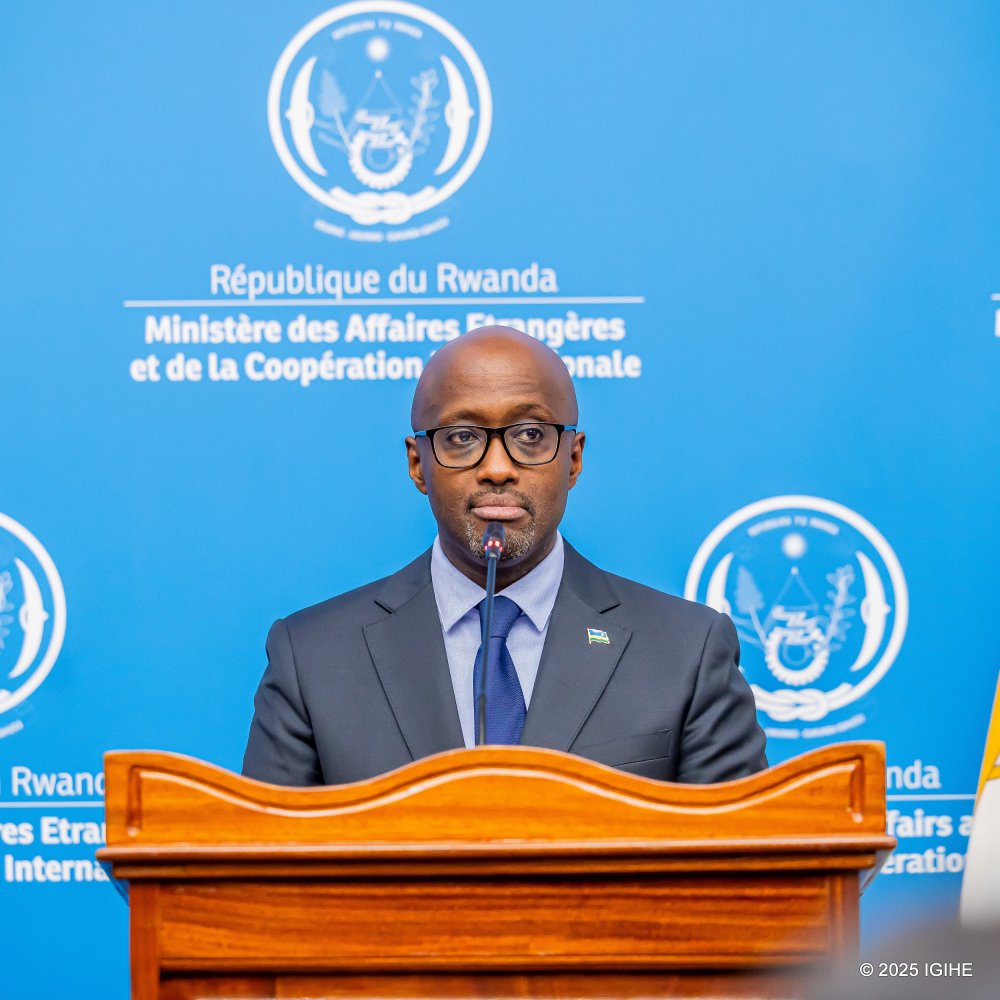
Rwanda’s Foreign Affairs Minister Olivier Nduhungirehe has raised questions over the decision by the Democratic Republic of Congo (DRC) to return Major General Sylvain Ekenge to his former role as spokesperson for the Armed Forces of the Democratic Republic of Congo (FARDC).
Ekenge had been suspended from the position in December 2025 following remarks he made on the Congolese national broadcaster RTNC that were widely condemned as discriminatory towards the Tutsi community. His return to the military’s communications role became publicly apparent in September, when his name appeared on a FARDC statement concerning an aircraft crash in Kenge, Kwango Province.
Nduhungirehe reacted to the development in a post on X, describing Ekenge’s reinstatement as “troubling and inappropriate” and questioning what the decision says about how the DRC is addressing the remarks that led to his suspension.
The minister argued that bringing Ekenge back to the position could raise broader questions over whether anti-Tutsi hate speech and what he describes as genocide ideology in the DRC should be understood as the actions of isolated individuals or as something with wider political backing.
That interpretation reflects Nduhungirehe’s position on the matter. It has not been established independently that the DRC government endorsed Ekenge’s previous remarks. In fact, when he was suspended in December 2025, the FARDC leadership said the statements did not represent the official position of the country, the president or the government.
Nduhungirehe also questioned the manner in which Ekenge’s return became public, arguing that it appeared to have been communicated without a separate explanation of why his suspension had been lifted.
The minister went back to the statements that led to Ekenge’s removal from the spokesperson’s position.
During a December 27, 2025 appearance on RTNC, Ekenge warned Congolese men about marrying Tutsi women and made allegations involving Tutsi men supposedly being brought into family homes under the guise of being relatives. The comments prompted condemnation and led to his suspension by the FARDC General Staff.
Nduhungirehe compared the remarks with the rhetoric contained in the so-called “Ten Commandments of the Hutu”, a text published in Rwanda in 1990 by Hassan Ngeze, who was later convicted by the International Criminal Tribunal for Rwanda for his role in genocide-related propaganda.
The Rwandan minister further noted that Ekenge was suspended but, according to his account, was not prosecuted over the remarks. He questioned why the officer had been allowed to return to the same communications position about nine months later.
The issue comes against the backdrop of continuing tensions between Rwanda and the DRC, with both governments frequently trading accusations over security, armed groups and ethnic rhetoric in eastern Congo.
While Kinshasa has not publicly provided, in the reporting reviewed, a detailed explanation for Ekenge’s return, the development has already generated competing reactions in the DRC and Rwanda.