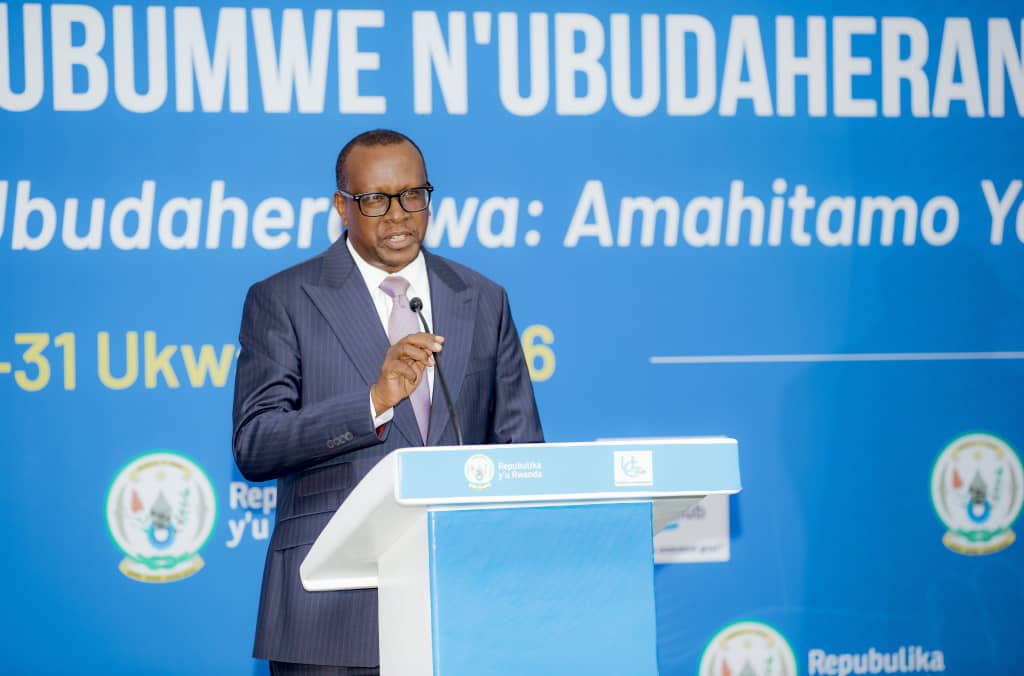
Minister of National Unity and Civic Engagement Dr Jean Damascène Bizimana has described the death of Callixte Mbarushimana without facing trial over allegations related to the 1994 Genocide against the Tutsi as a failure of justice.
Mbarushimana died in France on October 4, 2026, aged 63, while a French investigation into allegations linked to the Genocide was still unresolved. A French court had ordered the investigation to resume in May 2025.
Bizimana said Mbarushimana was among those involved in planning and carrying out the Genocide and had spent years as secretary general of the FDLR, an armed group operating in eastern Democratic Republic of Congo.
“Callixte Mbarushimana’s death in France on October 4, 2026, is a clear failure of justice. Among the intellectuals who planned and actively carried out the Genocide against the Tutsi was Callixte Mbarushimana, who died after spending many years as secretary general of the genocidal FDLR,” Bizimana said.
He said Mbarushimana died while wanted by the justice system, with efforts aimed at bringing him before French courts or transferring him to Rwanda.
Bizimana also described Mbarushimana as a prominent member of the Coalition for the Defence of the Republic (CDR), saying he died without renouncing hatred, ethnic discrimination and genocide ideology.
The minister said Mbarushimana’s death without trial reflected shortcomings in the international justice system, arguing that he had been arrested several times but released while investigations continued.
“International justice arrested him several times and released him on the grounds that investigations were still ongoing, despite the availability of evidence. The slow pace of justice has allowed notorious genocide suspects who fled abroad, such as Félicien Kabuga, Claver Kamana, Michel Bakuzakundi and Alphonse Ntilivamunda, among others, to die without being questioned about the grave crime of genocide they committed,” he said.
Bizimana said Mbarushimana’s death should prompt international justice institutions to accelerate cases involving genocide suspects living abroad.
Mbarushimana’s alleged role in the Genocide
Mbarushimana was born in Ndusu, in the former Ruhengeri Prefecture, now Musanze District, on July 24, 1963.
He initially worked for the United Nations Development Programme (UNDP) in Kigali, specialising in information technology. He remained in Rwanda after foreign UN staff left the country when the Genocide against the Tutsi began in April 1994.
He was later accused of using his position at UNDP to assist government forces and Interahamwe militia. Allegations against him included providing vehicles and equipment, helping compile lists of people targeted for killing and being involved in the killing of UNDP staff, including Florence Ngirumpatse.
However, Mbarushimana was never convicted of these allegations. The International Criminal Tribunal for Rwanda examined his case but did not indict him.
He later joined the FDLR and rose to senior positions within the group. In 2007, he became its executive secretary responsible for political affairs and operated from France.
On March 3, 2009, the UN Security Council placed him under sanctions, accusing him of obstructing efforts to disarm FDLR fighters and facilitate their return.
On September 25, 2010, the International Criminal Court issued an arrest warrant for Mbarushimana over alleged war crimes and crimes against humanity committed by FDLR fighters in North and South Kivu in 2009. The charges were not ultimately confirmed by the court.
French police arrested him in Paris on October 3, 2010, and he was transferred to The Hague on January 25, 2011.
In December 2011, ICC judges ruled that the evidence presented by prosecutors was insufficient for the case to proceed to trial. He was released on December 23, 2011, and the prosecution’s appeal did not change the decision. The ICC case was subsequently closed.
Despite his release by the ICC, a separate investigation continued in France into allegations concerning his alleged role in crimes committed during the 1994 Genocide against the Tutsi.
In October 2024, a French judge decided to close that investigation, citing concerns over witness testimony.
However, on May 21, 2025, the Paris Court of Appeal ordered the investigation to be reopened, saying that some evidence had not been sufficiently examined and that further investigation was necessary. A 2025 United Nations report also confirmed the reopening of the investigation.
Mbarushimana died in France before the investigation could be brought to trial. He had not been convicted of the allegations against him.