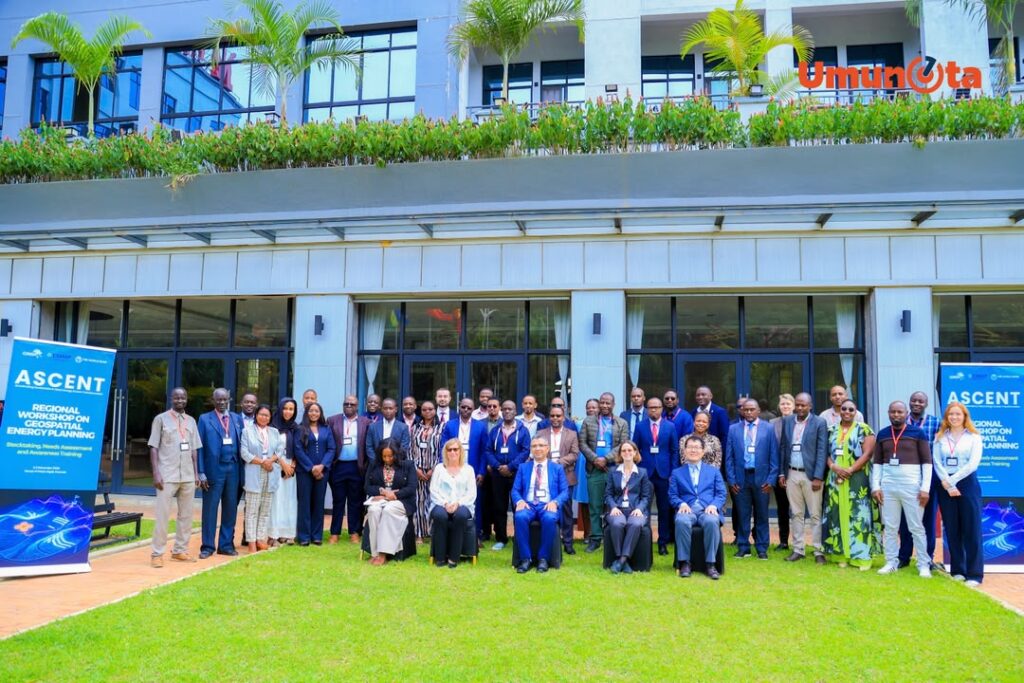
The Common Market for Eastern and Southern Africa (COMESA), the World Bank and Climate Compatible Growth (CCG) have joined forces to strengthen countries’ capacity to use geospatial technology in planning electricity access across Africa.
The partners are meeting in Kigali for a two-day workshop that began on November 2, 2026, bringing together energy experts, country representatives and development partners to exchange knowledge on how location-based data can improve decision-making and the expansion of electricity services.
The workshop is being held under the Accelerating Sustainable and Clean Energy Access Transformation in Eastern and Southern Africa (ASCENT) programme, which supports the Mission 300 initiative to connect 300 million people to electricity across Africa.
Dr Ahmed Abdallah, an energy economist with COMESA, said the partnership aims to help countries identify the most effective and affordable ways to extend electricity access to their populations.
“The challenge is no longer simply to increase the number of people connected to electricity or expand power networks. It is about finding the most appropriate and efficient ways to provide electricity to communities at the lowest possible cost,” he said.
He identified limited access to reliable data and inadequate technical capacity to use modern technologies in energy planning as some of the major challenges facing countries.
Geospatial technology uses location-based information to establish where people live, map existing electricity networks and identify areas that remain underserved. This enables planners to determine the most suitable and cost-effective options for extending electricity access.
Abdallah cited remote rural communities as an example, explaining that planners can compare the cost of extending existing power networks, connecting communities to a neighbouring country’s grid or using solar power systems.
Jana Rysankova of the World Bank said electricity planning should not be treated as a one-off exercise, as changes in population patterns and technological developments can quickly make existing plans outdated.
She stressed the need for countries to regularly update their plans to reflect these changes, citing mesh grids, which are small interconnected electricity networks, as an emerging option for expanding access.
Vivien Foster, International Partnerships Lead at CCG, highlighted the importance of involving universities and researchers in strengthening energy planning.
She said countries need to connect scientific knowledge with policymaking to develop local expertise capable of conducting research and supporting the implementation of energy plans.
Kenta Usui of the World Bank’s Energy Sector Management Assistance Program (ESMAP) highlighted the role of geospatial data in identifying communities and institutions that need electricity.
He also emphasised that energy planning should be coordinated with other sectors, including health, agriculture, education and telecommunications, to ensure electricity reaches areas where it can support different development activities.
COMESA is establishing framework agreements with companies that provide geospatial planning services through its Advisory Facility. The arrangements are intended to help member states develop or update their electrification plans and present them more clearly.
Representing Rwanda, Jovine Nsekanabanga of the Energy Development Corporation Limited (EDCL), a subsidiary of Rwanda Energy Group (REG), said the country had made progress in electricity planning but still faced gaps in data collection and quality assurance.
“There is still a need to strengthen capacity to collect data and ensure that the information used in planning is accurate, reliable and of good quality. Another important issue is aligning different plans so that they complement one another and provide useful guidance to investors and project implementers,” he said.
The workshop will assess how participating countries currently plan to expand electricity access, identify gaps in knowledge and technical capacity, and agree on priority areas requiring technical assistance.
Rudolf Yeganyan, head of the Capacity Building Unit at CCG, said each country is expected to identify areas requiring improvement, appoint focal points to follow up on the process and agree on the next steps for requesting support.
He explained that the approach is designed to ensure countries take ownership of identifying their challenges, determining the support they need and following up on actions agreed during the workshop.
The meeting forms part of broader efforts to strengthen energy planning capacity in Eastern and Southern Africa through reliable data, technology and cooperation among different institutions.