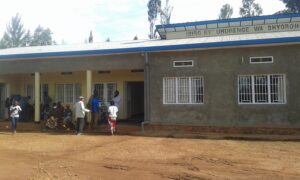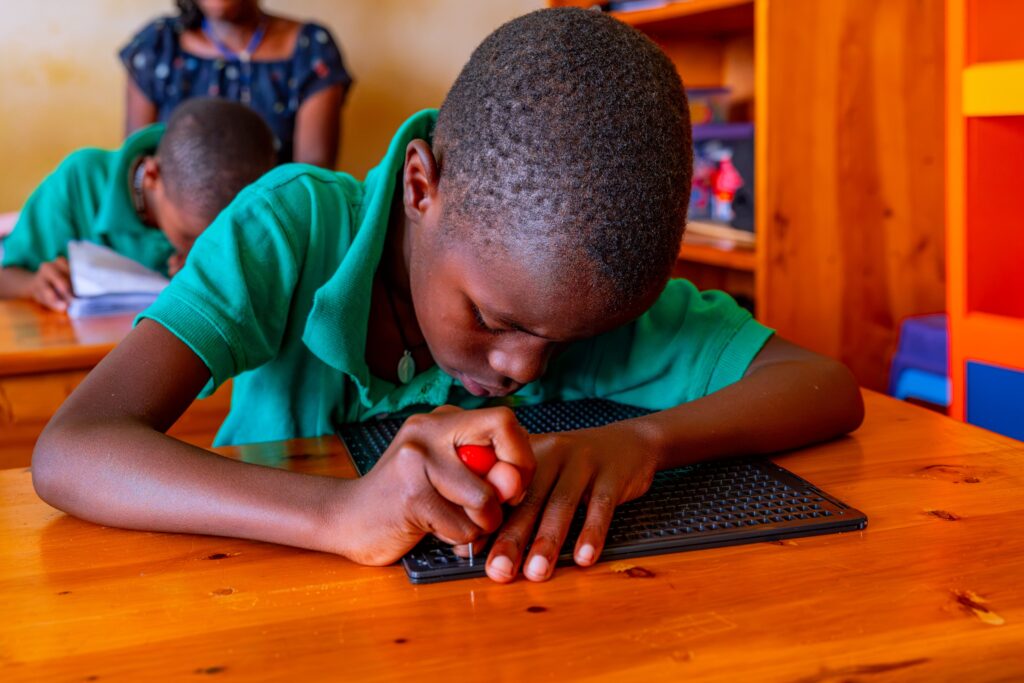
At the Educational Institute for Blind Children in Kibeho, Nyaruguru District, visually impaired students are learning alongside their peers, using specialised tools that enable them to read, write, study and even operate computers.
The school is among the institutions supporting Rwanda’s commitment to inclusive education, ensuring that children with disabilities have access to learning opportunities and can perform well academically.
This was demonstrated on Monday, November 9, 2026, when a delegation comprising officials from the Ministry of Education, the Rwanda Basic Education Board (REB) and other education stakeholders visited the school.
The institution has 100 visually impaired students, offering education from primary through secondary school. Some former students have returned as teachers, helping other children with visual impairments access education.
At first glance, the school resembles any other learning institution, with classrooms and other facilities. However, it also has specialised equipment and learning materials that enable visually impaired students to study independently, acquire literacy and numeracy skills, and use computers.
The Educational Institute for Blind Children is run by the Franciscan Sisters Servants of the Cross. It has earned recognition for its academic performance. In the 2025/26 national secondary school examinations, one of its students, Habumugisha Samuel, who is visually impaired, ranked first nationally in the Languages combination.
Learning to read and write through Braille
Students are first introduced to Braille, a writing system that enables people with visual impairments to read and write through touch.
Using specially designed materials, they learn to recognise letters by feeling raised dots, allowing them to read books, write notes and follow lessons.
Ndayisenga Daniel, who joined the school in 2015 at primary level and is now nearing the completion of secondary education, said Braille is one of the most important tools in their learning.
He explained that students are taught the system when they arrive at the school, enabling them to develop reading and writing skills.
“We also have 24 letters, just like everyone else, but they are written differently from the ones you use,” he said.
He added that students do not need much time to master the system and begin writing words using the Braille characters they can read through touch.
The school also provides Braille textbooks and other learning materials, as well as computers adapted for use by visually impaired students.
However, students say some technological limitations continue to affect their learning.
Uwera Delisee, who is completing secondary school in the Languages combination of English, French and Kinyarwanda, said some digital learning tools cannot read certain content, making it difficult to access all the information they need.
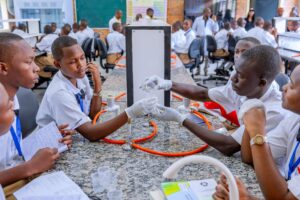
“Sometimes the equipment is insufficient, and we also have too few laboratories,” she said.
Beyond classroom activities, students take part in sports and cultural activities. They play specially adapted football, dance and participate in a traditional dance troupe, demonstrating that school life extends beyond academics.
Despite these achievements, the institution cannot accommodate all the children who wish to enrol, leaving some without access to its specialised learning environment.
Other public, government-aided and private schools across the country also admit learners with disabilities and provide facilities to support their education.
Why blind students mainly study languages
REB Deputy Director General Dr Flora Mutezigaju said visually impaired students can currently pursue education through secondary school, but the country still lacks sufficient specialised technology to enable them to study subjects such as mathematics and science effectively.
She explained that available equipment mainly supports reading and writing, making language subjects more accessible. However, developing tools that can help blind students understand scientific concepts and mathematical content remains a challenge.
“It is technology that we have not yet reached the level of, but we will get there,” she said.
Rwanda steps up efforts to expand inclusive education
The fourth Sustainable Development Goal calls on countries to ensure inclusive and equitable quality education for all by 2030.
A Ministry of Education report released on March 30, 2026, on the state of education in Rwanda during the 2024/25 academic year, showed that the country had 43,663 learners with disabilities, representing 0.9 per cent of the 4.8 million students enrolled across all levels of education.
Of these, 3,514 were enrolled in pre-primary education, while more than 31,000 attended primary school. Secondary schools had 5,559 learners with disabilities.
In Technical and Vocational Education and Training (TVET) institutions, enrolment reached 745, while universities and other higher learning institutions had 1,479 students with disabilities.
Physical disabilities accounted for the largest proportion of learners with disabilities at 32.6 per cent, followed by specific learning difficulties at 18 per cent, visual impairments at 14 per cent and developmental difficulties at 13.1 per cent.
The report also found that 68.8 per cent of schools had infrastructure that facilitates access for learners with disabilities, indicating that more investment is needed to make learning environments accessible to all.
Rwanda’s inclusive education efforts also extend to refugee children. The country had 45,671 refugee students enrolled in schools, including 6,008 in pre-primary education. The latter figure represented a 5.6 per cent increase from 5,689 in the 2023/24 academic year.