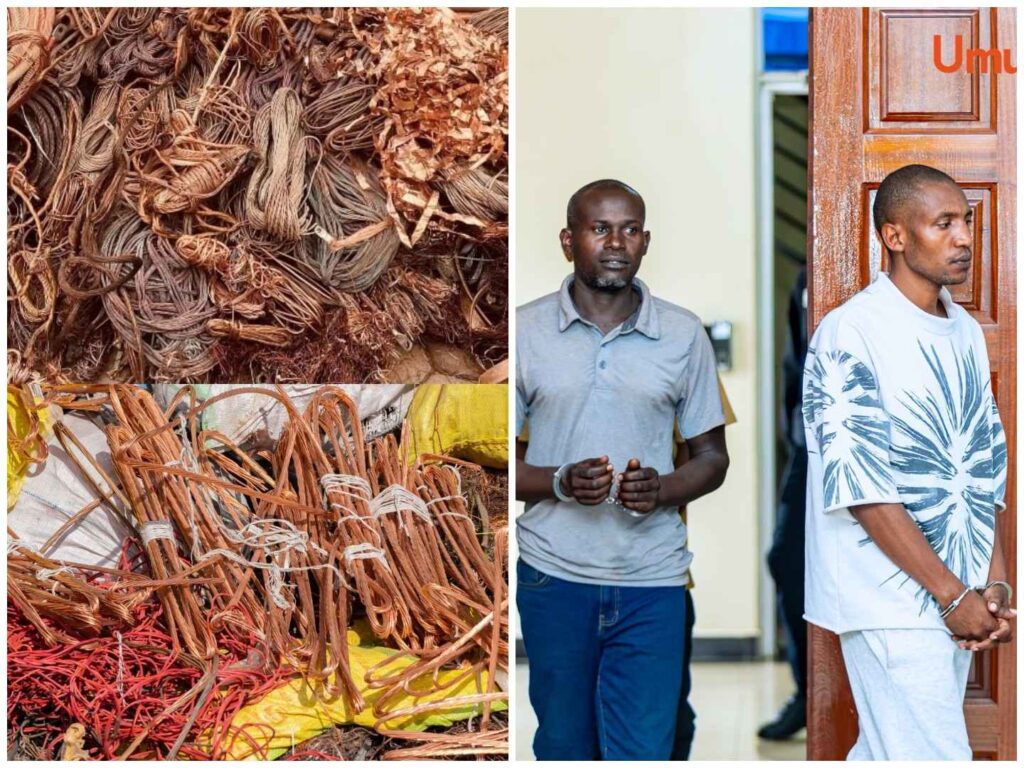
The Rwanda Investigation Bureau (RIB) has presented 11 people suspected of stealing and damaging public infrastructure, including electricity equipment, by cutting and taking copper cables from different parts of the country.
The suspects were found with 1.5 tonnes of copper cables valued at more than Rwf20 million. The cables were allegedly stolen from Gasabo, Kicukiro, Nyarugenge, Kamonyi and Bugesera districts.
They were presented to the media on Tuesday, November 3, 2026.
The group includes a Ugandan national suspected of organising the transportation of the stolen cables to other countries, as well as people accused of buying and transporting them, including motorcyclists and drivers.
The suspects were arrested in a joint operation by RIB and the Rwanda National Police. They face three charges: forming or joining a criminal organisation, damaging electricity infrastructure or equipment, and theft.
They are being held at RIB stations in Kicukiro and Nyarugenge, while their case files have already been submitted to the National Public Prosecution Authority.
RIB spokesperson Dr Murangira B. Thierry said anyone convicted of stealing electricity cables faces a prison sentence of between three and five years.
He warned that stealing or damaging electricity cables and other public infrastructure should not be treated as an ordinary offence, given the impact on communities and the country.
“Infrastructure is public property. It does not belong to specific individuals; it belongs to all of us. Damaging or stealing it does not only cause losses to a particular company or individual, but also harms the country and undermines people’s welfare,” he said.
He urged the public to report suspected theft or vandalism of infrastructure, particularly electricity equipment, adding that RIB and the police would not tolerate such offences.
“If you think this is an easy way to make money, we urge you to look for another job. Otherwise, we will not go easy on you. We have the determination, capacity and cooperation of the public to fight these crimes,” he said.
Dr Murangira added that cable theft is often driven by buyers who pay people to steal the materials and transport them to other countries. He said the existence of a market for stolen cables encourages the crime to continue despite enforcement efforts.
“These activities are fuelled by people who provide money to buy the stolen cables. Stolen property has no value if there is nowhere to sell it. When people create a market for these materials, the crimes continue,” he said.
Among those arrested are two women suspected of involvement in forming or joining a criminal organisation. Under Article 224 of the law determining offences and penalties in general, anyone convicted of this offence faces a prison sentence of between seven and 10 years.
The offence of damaging electricity infrastructure or equipment is punishable under Article 51 of the same law by imprisonment of between three and five years and a fine ranging from Rwf1 million to Rwf5 million.
The article covers anyone who damages or destroys electricity meters, machines, equipment, cables or other infrastructure used in the supply of electricity, or causes or permits such damage or destruction. It also criminalises actions that prevent electricity meters from recording consumption accurately.