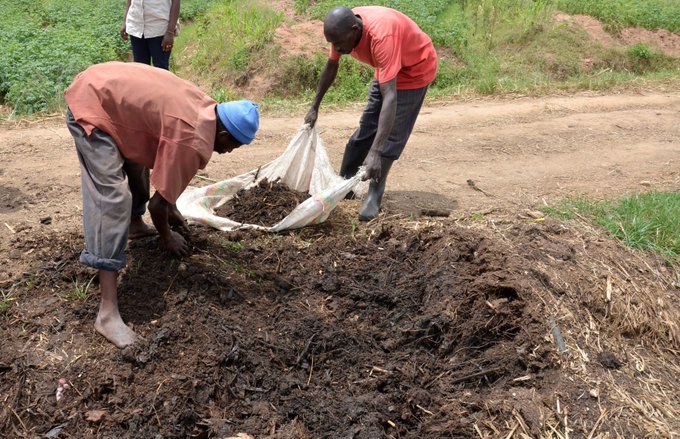
About 89.9 percent of farmers implemented soil erosion control measures on their farmland, representing a 0.8 percent increase compared to the same season last year. Meanwhile, the use of organic fertilizer Rises by 6.9% percent over the same period.
These findings are highlighted in the Seasonal Agricultural Survey (SAS) for 2025 Season B, released by the National Institute of Statistics of Rwanda (NISR) on October 23, 2025.
NISR conducted the agricultural data collection exercise to provide reliable and up-to-date information that supports planning, monitoring, and evidence-based decision-making in the agriculture sector.
The data collection started on April 21, 2025, and was concluded on June 30, 2025. It covered all 30 districts of the country, gathering data from 1,200 segments and 379 large-scale farmers.
According to the report, Rwanda’s total land area is estimated at 2.376 million hectares, of which 1.423 million hectares representing about 60 percent of the total are used for agricultural purposes.
During Season B 2025, 1.022 million hectares were planted with seasonal crops, 0.524 million hectares with permanent crops, while 0.1 million hectares were used for permanent pasture.
The survey showed that 18 percent of farmers used improved seeds during the season. Among them, 16.7 percent were small-scale farmers (SSF), while 72.1 percent were large-scale farmers (LSF).
Organic fertilizer was used by 80.8 percent of farmers 81.2 percent among small-scale farmers and 63.8 percent among large-scale farmers. Meanwhile, inorganic fertilizer was applied by 55.5 percent of all farmers, including 54.8 percent of small-scale farmers and 83.7 percent of large-scale farmers.
During the same season, 36.6 percent of farmers used pesticides, including 35.6 percent of small-scale farmers and 77.7 percent of large-scale farmers. The most commonly used pesticides were Rocket (30.4%), Dithane (24.3%), and Cypermethrin (16.1%).
The Seasonal Agricultural Survey is one of NISR’s key statistical activities conducted twice a year to produce accurate and timely agricultural data. These statistics play a vital role in informing national development strategies, guiding policymakers, and supporting the sustainable transformation of Rwanda’s agriculture sector.