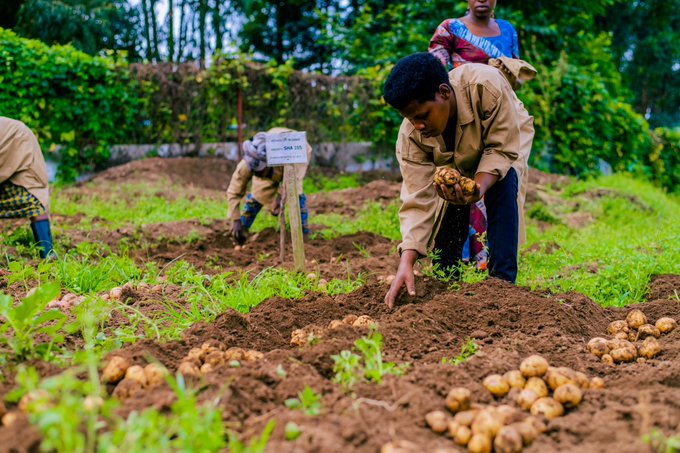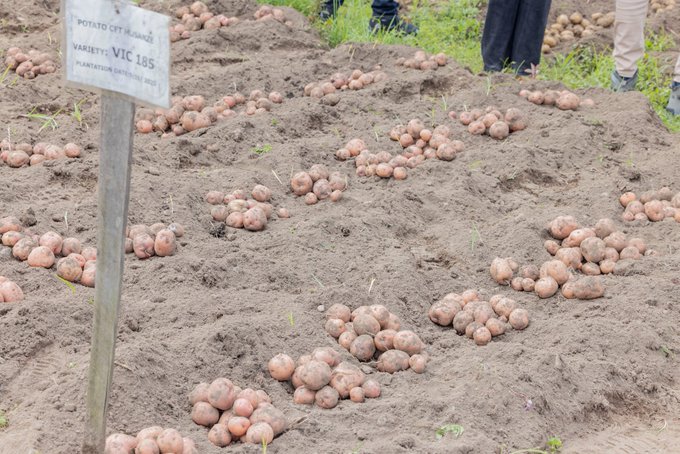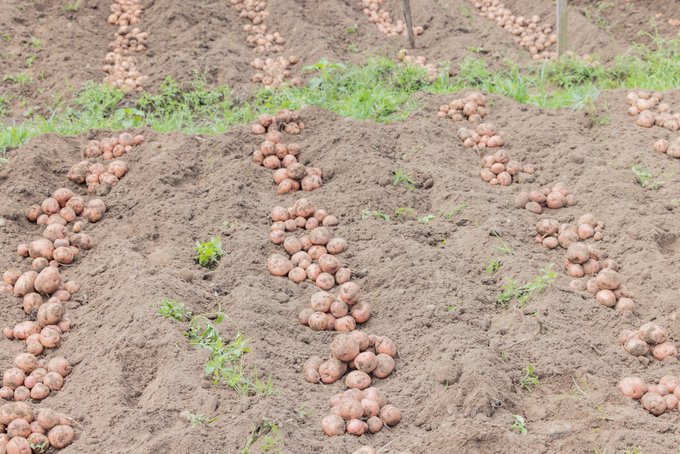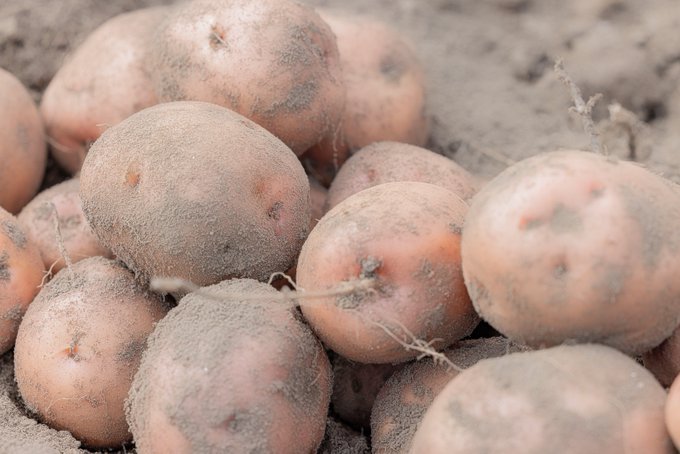
The Rwanda Agriculture and Animal Resources Development Board (RAB) has unveiled upgraded potato seed varieties, Ndamira and Victoria, the seeds that are expected to significantly boost potato production after trials recorded yield increases from eight to 35 tonnes per hectare.
Developed using modern agricultural technology, the improved varieties have been enhanced to withstand climate stressors such as excessive rainfall and high temperatures, while requiring no chemical spraying, a move expected to lower production costs for farmers.
RAB said the seeds underwent extensive field trials and demonstrated strong resistance to common potato diseases, alongside improved adaptability to climate variability.
Athanase Nduwumuremyi, a researcher at RAB in charge of the potato programme, said the upgraded varieties provide a practical solution to long-standing challenges faced by potato farmers.
“Both Ndamira and Victoria come as a solution for farmers and the country in many ways,” Nduwumuremyi said. “They do not require spraying because they have been strengthened to cope with heat and heavy rainfall, yet they deliver impressive yields.”
He noted that trial results exceeded expectations.
“In our trials, areas that used to produce eight tonnes yielded up to 35 tonnes. We are confident that once farmers adopt these varieties, they will be satisfied with the output,” he said.
Nduwumuremyi explained that the two varieties were selected because they were historically high-yielding but had gradually lost productivity due to disease susceptibility, prompting RAB to enhance their resilience and restore their performance.
He added that the next step is to submit the varieties to the Rwanda Inspectorate, Competition and Consumer Protection Authority (RICA) for certification. Once approved, the seeds will be handed over to seed multipliers before being distributed to farmers nationwide.
Farmers who participated in or observed the trials said the new varieties could be transformative, particularly by reducing expenditure on pesticides while increasing yields.
Uwase Christella, a potato seed multiplier from Gicumbi District, said the varieties’ ability to withstand climate stress is a major breakthrough for farmers.
“Climate change and diseases are among the biggest challenges in potato farming. These improved seeds give us hope that production can increase without heavy losses,” she said, adding that farmers are ready to begin seed multiplication once approval is granted.
Similarly, Semarembo Felecien, a potato farmer from Cyanika Sector in Burera District, said the reduced need for chemicals is a major advantage.
“Pesticides are expensive, and sometimes crops still fail even after spraying. Having varieties with built-in resistance means we will save money and reduce risks,” he said.
Potatoes are among Rwanda’s most widely cultivated crops. According to the Ministry of Agriculture and Animal Resources, the country produced about 850,000 tonnes in 2024, with a national target of reaching at least 1.5 million tonnes annually to meet market demand.
Meanwhile, a recent report by the National Institute of Statistics of Rwanda shows that potato production increased by 17 percent in the 2025 farming seasons compared to all seasons in 2024, reflecting steady growth in the sector.