Following a Cabinet reshuffle, new leadership has been appointed at the Ministry of Infrastructure (MININFRA), with a three-person team now tasked with steering one of the government’s most critical sectors.
The ministry assumes office amid renewed concern over delays in key infrastructure projects, including roads, dams, hospitals, and public facilities—some of which have stalled for years, increasing costs and slowing service delivery.
The new leadership includes Murwanashyaka Damien as Minister of Infrastructure, alongside Zingiro Armand and Col. Bizimungu Claudien as State Ministers.
Pressure mounts over delayed projects
Recent findings from the Auditor General and parliamentary oversight bodies highlight persistent inefficiencies in project execution. Several contracts have exceeded their completion timelines, while others remain unsigned or have stalled despite funding commitments.
According to the Auditor General’s 2025/2026 report, 32 government contracts worth Rwf 177.14 billion have surpassed deadlines, with some projects delayed by up to six years before commencement.
In addition, 119 contracts valued at Rwf 684.56 billion remain unsigned, delaying planned infrastructure works. Six donor-funded projects worth Rwf 399.91 billion have been signed but not yet started, while 23 stalled construction projects valued at Rwf 19.02 billion remain incomplete.
Road projects among the most affected
Transport infrastructure remains among the hardest hit.
The Kigali–Muhanga road expansion, a 46-kilometer project valued at over Rwf 140 billion, was expected to begin in 2023 in two phases but remains pending, with sections between Kigali, Bishenyi, and Muhanga continuing to deteriorate.
The 10-kilometer Masaka–Prince House road project, estimated at Rwf 80 billion, is also delayed due to ongoing land acquisition and resettlement processes, despite initial plans to begin in 2022.
The Ngoma–Ramiro road project, spanning 52 kilometers and launched in October 2021 at a cost of Rwf 64 billion, has also fallen behind schedule. While works in Bugesera are largely complete, significant sections in Ngoma remain unfinished beyond the 2023 completion target.
Health and education infrastructure delayed
The health sector has recorded some of the longest delays. Six donor-funded projects worth Rwf 239.2 billion have experienced setbacks of up to 31 months.
These include Muhororo Hospital in Ngororero, Kabgayi Hospital in Muhanga, and Ruhengeri Hospital in Musanze. Technical and vocational education schools in Cyanika (Nyamagabe) and Muhororo (Ngororero), valued at Rwf 10.4 billion, have also been delayed for more than two years.
High-profile projects under scrutiny
Several flagship national projects remain behind schedule.
The Nyabugogo Bus Terminal redevelopment in Kigali, first announced in 2017, has yet to begin construction despite earlier plans to start in 2025 and complete by 2027.
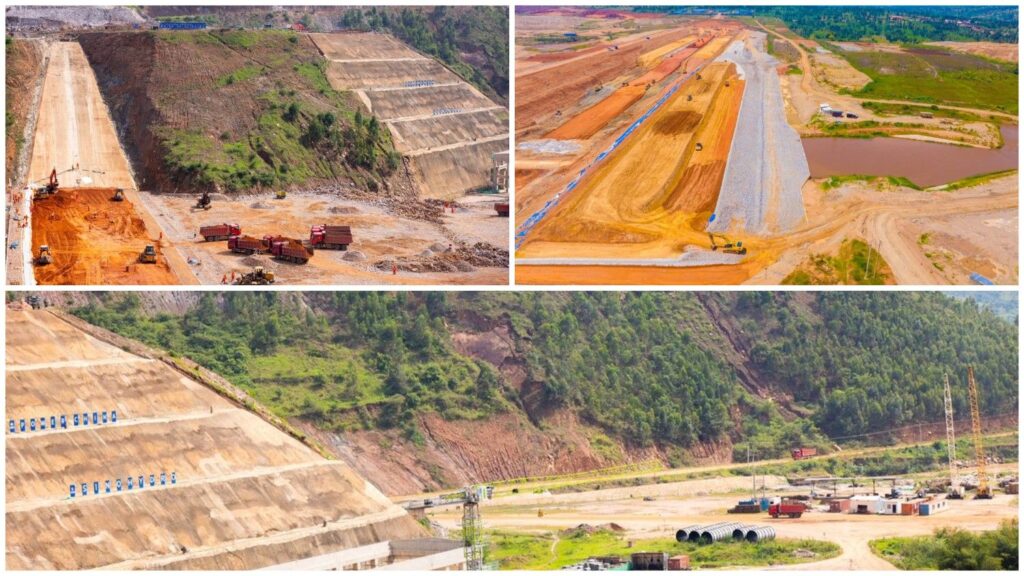
The Muvumba Multipurpose Dam in Nyagatare District, valued at Rwf 102.7 billion, is currently about 55% complete, behind its projected timeline. The project has previously drawn presidential attention over uneven progress, particularly delays in its hydropower component.
The Nyabarongo II Hydropower Plant, designed to generate 43.5 MW, is also behind schedule at about 69% completion, missing its original 2024 delivery target.
Government outlook
Despite these challenges, MININFRA reports that overall implementation of major infrastructure projects stands at 91%.
However, the scale of delayed and stalled projects presents a significant challenge for the incoming leadership, which is expected to accelerate delivery, address bottlenecks, and restore momentum in the sector.