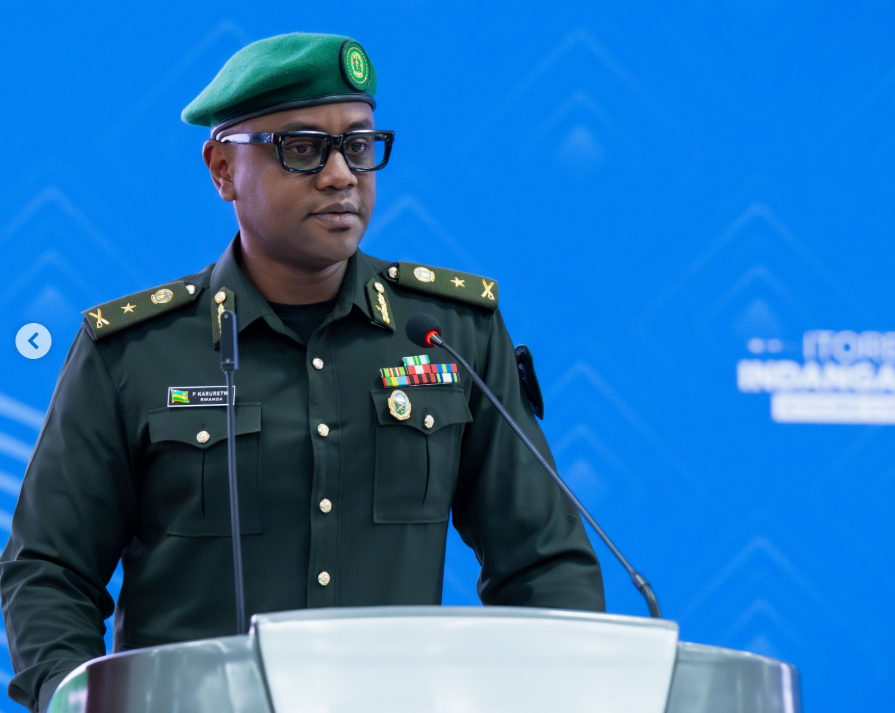
The integration of former Rwanda Patriotic Army (RPA) and former Rwandan Armed Forces (FAR) soldiers after the 1994 Genocide against the Tutsi demonstrated that Rwanda’s greatest enemy was not the soldier on the battlefield but bad governance, Rwanda Defence Force (RDF) spokesperson Brig. Gen. Patrick Karuretwa has said.
Speaking during an interview with the Rwanda Broadcasting Agency (RBA) as the country marked the 32nd anniversary of Liberation, Brig. Gen. Karuretwa reflected on the evolution of the RDF since the end of the liberation struggle, describing the post-war integration of former rival forces as one of the country’s most significant nation-building decisions.
He said that despite emerging victorious in the liberation war, the RPA chose to integrate former FAR soldiers into the national army, sending a powerful message that reconciliation and national unity would take precedence over division and retribution.
“The integration of the RPA and the defeated forces sent a strong message to former FAR soldiers and to all Rwandans that the enemy was not the individual or the soldier fighting on the battlefield. The real enemy was bad governance. Once someone abandons that system, they are no longer an enemy,” Brig. Gen. Karuretwa said.
The integration process began at the Gako Military Academy shortly after the liberation of the country, where former FAR personnel were admitted into the RPA.
According to Brig. Gen. Karuretwa, between July and October 1994, just three months after the Genocide against the Tutsi, 76 former FAR officers and soldiers had joined the RPA. Between 1995 and 1998, more than 10,000 former FAR personnel were integrated into the national army.
He said the integration reflected the broader vision of rebuilding Rwanda on the principles of unity and equal citizenship after decades of divisive politics that culminated in the 1994 Genocide against the Tutsi.
“Liberation marked the beginning of rebuilding the country based on a new vision, one that is fundamentally different from the past and allows every Rwandan to live in their country without discrimination. It represented a new beginning for the nation, which is why Liberation Day remains such an important milestone in Rwanda’s history,” he said.