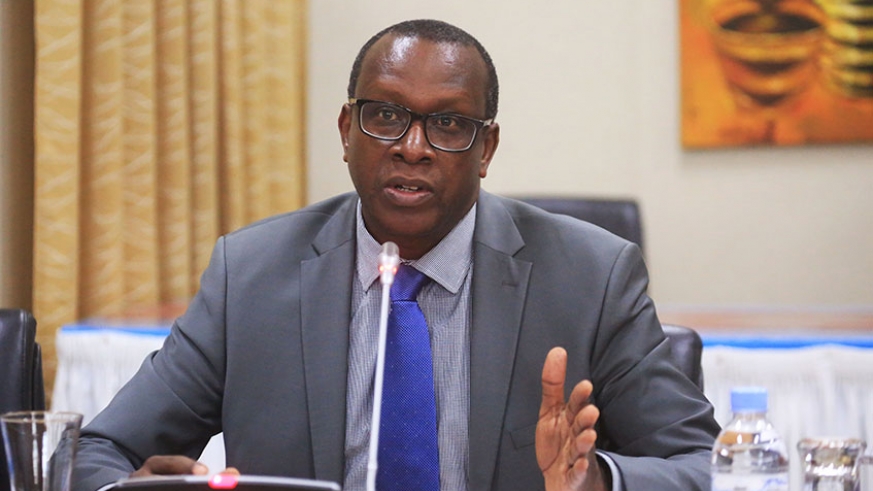
Minister of National Unity and Civic Engagement Dr Jean Damascène Bizimana has said the conviction of Dr Eugène Rwamucyo by a French appeals court proves that individuals accused of genocide crimes cannot escape justice by fleeing abroad.
The Paris Court of Appeal upheld Rwamucyo’s conviction for genocide and crimes against humanity committed during the 1994 Genocide against the Tutsi in Butare, confirming the sentence handed to him by a lower court.
Reacting to the ruling, Bizimana described it as a significant step in delivering justice to survivors and families of victims, while commending France’s efforts to prosecute genocide suspects over the past decade.
“This decision concludes a long judicial process for survivors and families of victims of the genocide and shows that the truth cannot be hidden forever,” Bizimana said.
He said the case demonstrates that genocide suspects cannot rely on living in foreign countries to avoid accountability.
“The Rwamucyo case shows that refuge abroad does not provide immunity for genocide perpetrators. Wherever they are, justice can reach them,” he said.
Bizimana said Rwamucyo attempted during the trial to deny the involvement of certain individuals in the genocide and disputed claims that Tutsi victims were killed at facilities where he worked, including the former University of Rwanda health centre and Butare University Teaching Hospital (CHUB).
He said evidence presented before the court, including witness testimonies, confirmed that Tutsi patients and staff were killed at those facilities.
Bizimana cited testimony from Dr Rony Zachariah, who worked with Médecins Sans Frontières at CHUB during the genocide, saying between 150 and 200 people, including Tutsi staff and patients, were removed from the hospital and killed.
Rwamucyo had also argued that he was not aware of any doctors or nurses who participated in the genocide in Butare. Bizimana rejected that claim, saying judicial records show that some medical professionals were involved in genocide crimes.
He said Gacaca courts convicted 29 doctors and 31 nurses working in different health facilities in Butare for genocide-related offences.
“Evidence presented before the courts showed that the genocide was not carried out by only a few individuals. People from different sectors participated, including some who had responsibilities to protect lives,” Bizimana said.
The minister also addressed Rwamucyo’s claims regarding the former Gatonde Commune, where he said the Tutsi population was small. Bizimana said Tutsi residents there were targeted and killed like communities elsewhere in Rwanda, with multiple locations becoming scenes of massacres.
He thanked French judicial authorities for continuing to prosecute genocide cases, saying such efforts play an important role in fighting impunity and preserving historical truth.
“Justice for genocide crimes is not just about words. It is a responsibility to preserve the truth, honour victims and prevent the distortion of history,” Bizimana said.
Rwamucyo, a former lecturer at the National University of Rwanda, was accused of attending a meeting chaired by former prime minister Jean Kambanda in which intellectuals were encouraged to support the genocide.
French prosecutors also accused him of overseeing the burial of Tutsi victims killed in different parts of Butare using heavy machinery, including road construction equipment, arguing that the operation was intended to conceal evidence of the genocide.