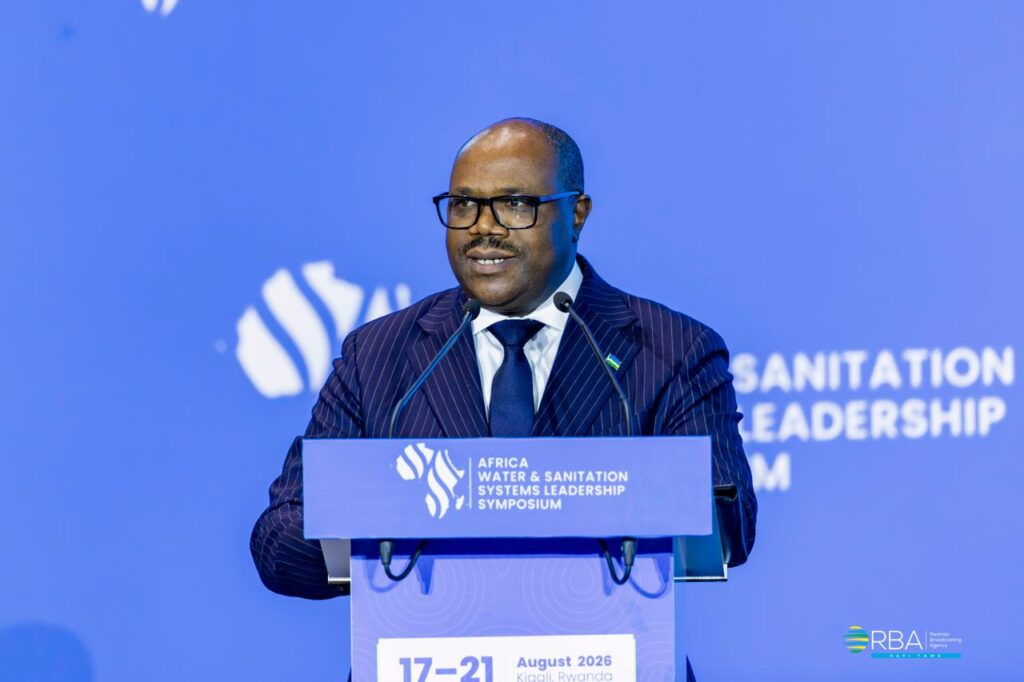
Rwanda’s Prime Minister, Dr. Justin Nsengiyumva, has called for stronger governance, capable institutions and sustainable financing to ensure that investments in water and sanitation infrastructure deliver reliable services to communities across Africa.
Nsengiyumva made the remarks on Tuesday, August 18, 2026, while officially opening the Africa Water & Sanitation Systems Leadership Symposium 2026 in Kigali.
The symposium brings together African leaders, policymakers, experts, financiers and development partners to discuss ways of improving water, sanitation and hygiene services across the continent.
The Prime Minister said infrastructure development is essential but cannot, on its own, solve Africa’s water challenges.
“Building infrastructure is important, but to a large extent, it is only the beginning. Ensuring that the built infrastructure functions effectively and reaches communities over the long term is the real measure of success,” Nsengiyumva said.
He said Africa needs effective institutions, political commitment, sustainable financing mechanisms and accountability to ensure that water and sanitation infrastructure continues to serve communities after construction.
“Governance driven by political commitment ensures that every infrastructure project continues to provide services to our citizens. These are the governance challenges we face, which is why this symposium is important,” he said.
Africa still faces major gaps
Nsengiyumva said the continent still has significant ground to cover in achieving the Sustainable Development Goals on water, sanitation and hygiene by 2030.
He cited figures showing that about 418 million people in Africa lack access to basic water services, while 779 million lack basic sanitation services and 828 million lack access to basic hygiene services.
“These figures should concern us deeply, not because Africa has failed to invest, but because despite the progress we have made, significant challenges remain,” he said.
The Prime Minister noted that African countries have invested heavily in water infrastructure, including water networks, water points and treatment plants.
However, he said the challenge increasingly lies in ensuring that such infrastructure remains functional and delivers services to the communities it was designed to serve.
Governance linked to economic gains
Nsengiyumva also highlighted the economic benefits that could come from improving governance in the water and sanitation sector.
He said stronger governance could help Africa save billions of dollars annually, while better domestic resource mobilisation could unlock additional financing for water and sanitation services.
He urged African countries to strengthen the institutions responsible for planning, financing, operating and maintaining water systems.
The symposium is providing a platform for participants to share experiences and explore practical solutions to the continent’s water and sanitation challenges.
For Nsengiyumva, the priority is therefore no longer simply to build more infrastructure, but to establish systems capable of ensuring that the infrastructure continues to function and reaches the people who need it most.