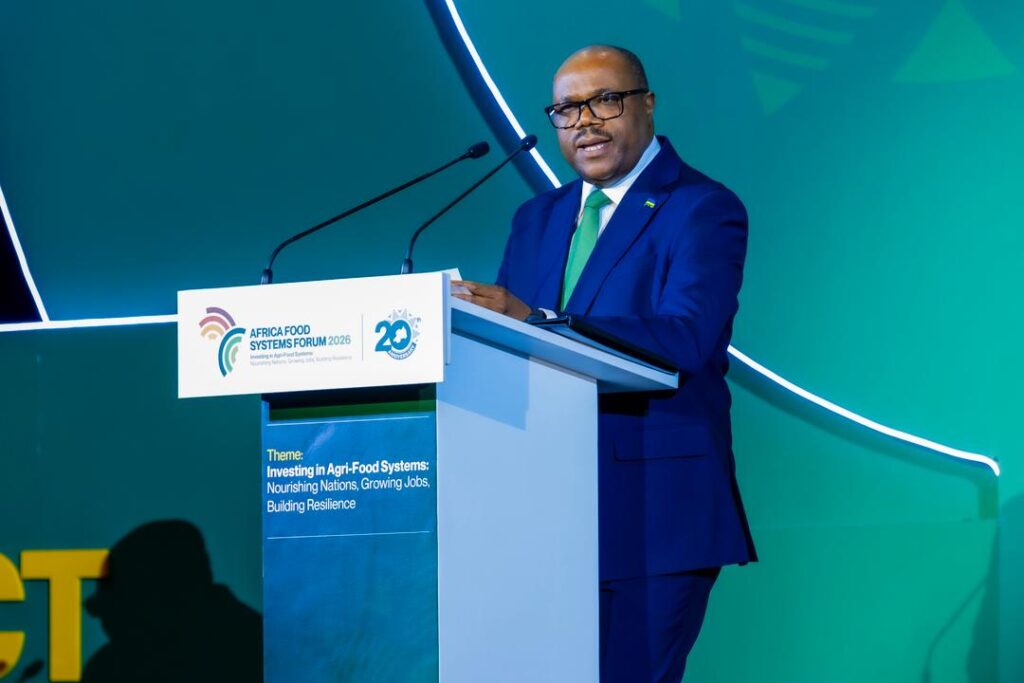
Rwanda’s Prime Minister, Dr. Justin Nsengiyumva, has urged African governments and investors to look beyond farm production and channel more capital into the wider food economy, arguing that agriculture cannot transform livelihoods without investment in the infrastructure, services and businesses that connect farmers to markets.
Addressing the Africa Food Systems Forum 2026 in Kigali, Nsengiyumva said Africa has significant opportunities across food value chains but needs stronger partnerships between governments, investors, farmers, financial institutions and other private-sector players to turn those opportunities into economic gains.
“The task before us is to build reliable partnerships that connect finance with these opportunities and ensure that the resulting benefits are fairly shared across all levels, particularly among smallholder farmers, women and young people,” he said.
The Prime Minister said the food economy encompasses far more than crop and livestock production. It includes irrigation, transport and logistics, energy, agricultural machinery, digital services, insurance, processing, distribution and trade.
He argued that treating agriculture as a standalone production activity limits its potential to create jobs and generate income.
“A productive farm cannot thrive without roads, energy, irrigation, storage, finance, logistics, processing and reliable markets. We need to look across the value chain and address the constraints that prevent viable enterprises from growing,” he said.
The call comes as Africa continues to face major food and nutrition challenges. At the forum, Nsengiyumva cited estimates that about 309 million Africans faced hunger in 2025, while around 57 percent experienced moderate or severe food insecurity.
He said investment therefore needs to target the wider systems that determine whether farmers can increase production, preserve their harvests, access markets and earn more from what they produce.
Smallholder farmers, who make up a large share of Africa’s agricultural workforce, often face limited access to capital, technology, insurance, equipment and reliable markets. Nsengiyumva said stronger links between finance and food-system opportunities could help address some of those constraints.
He also called for greater participation by young people and women in the food economy, including as entrepreneurs, investors and technology developers.
For Africa to attract more private capital, he said, countries must develop viable projects backed by strong institutions, realistic financing models and measurable targets.
“Across Africa, there is no shortage of promising innovations and successful solutions. The challenge has always been to finance, adapt and deploy these solutions across countries and communities while ensuring that growth translates into better nutrition, dignified employment and greater resilience,” he said.
Nsengiyumva’s message aligns with the broader focus of the 20th Africa Food Systems Forum, whose 2026 edition is centred on investment in agri-food systems, with emphasis on food security, climate resilience, youth and digital innovation, and trade and value chains. The forum is bringing together more than 5,000 stakeholders from over 50 countries in Kigali.
He urged stakeholders to move from commitments and pilot projects towards investments that can be scaled and produce measurable improvements for farmers, businesses and consumers.
“We have to first shift from knowledge to delivery, and second, shift from pilots to scale … and shift from commitments to measurable results,” he said.