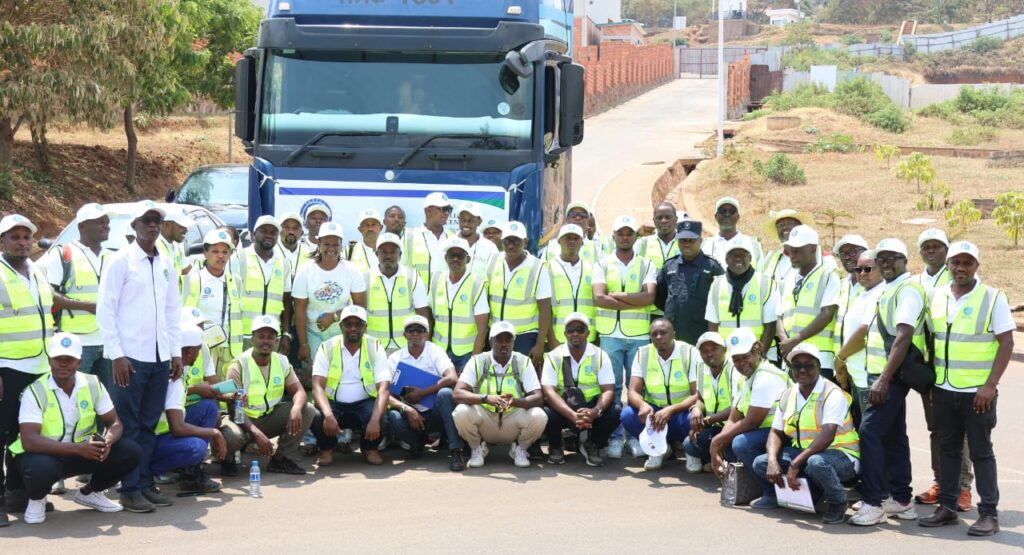
The Northern Corridor is turning to truck drivers as part of efforts to reduce greenhouse gas emissions from road freight transport in Rwanda, with training focused on fuel-efficient driving and environmentally friendly practices.
The initiative comes as freight traffic continues to generate significant emissions along the corridor, which links the Port of Mombasa in Kenya with Rwanda and other landlocked countries in the region.
The Northern Corridor’s Green Freight Strategy 2030 targets a 10% reduction in carbon-emissions intensity by 2030, alongside improvements in fuel efficiency and cleaner freight operations.
Across Rwanda, particularly on roads used heavily by long-distance trucks, vehicles can sometimes be seen emitting large amounts of smoke. While poor vehicle maintenance and mechanical problems can contribute to excessive emissions, experts also point to driving behaviour as an important factor.
The Northern Corridor is therefore training truck drivers to adopt eco-driving techniques that can reduce fuel consumption, lower emissions and improve road safety.
Jacqueline Dushimirimana, a cross-border truck driver who transports cargo through Uganda to Dar es Salaam and Mombasa and back to Kigali, says the training changed her understanding of the environmental impact of driving.
“We were made aware and encouraged to understand that we were among the people contributing to air pollution because we were driving without paying attention and did not know that we were harming the environment.”
She says she now pays greater attention to how she operates the engine, controls her speed and uses fuel.
Twizeyimana Abdalah, a truck driver with Trinity Logistics who operates along the Mombasa, Dar es Salaam and Uganda routes, says the training taught him how to use fuel more efficiently while reducing practices that contribute to air pollution.
“We learned how we should protect the environment and the clean air we breathe by avoiding fuel-use practices that produce excessive smoke because they affect the environment.”
He says the benefits could extend beyond the environment to transport companies and their employees.
If drivers use fuel more efficiently and reduce wastage, he argues, companies can save money and potentially improve earnings and salaries as productivity increases.
The training programme is being delivered by instructors including Lazarus Musyoka from Kenya and Kanyagisaka Justin, head of Rwanda’s association of truck drivers.
Musyoka says about 600 drivers have so far been trained, including 200 from Rwanda.
He says the programme is built around three key benefits: improving road safety, reducing transport costs and protecting the environment.
Kenya, where the training programme began, has already recorded encouraging results. According to Musyoka, an assessment of trained drivers found that their fuel consumption fell by about 10%.
“In Kenya, we first assessed the performance of the drivers we had trained and found encouraging results, with fuel consumption declining by 10%.”
An assessment is now expected to determine the impact of the training among drivers in Rwanda.
Kigali–Rusizi route emerges as emissions hotspot
The push for cleaner freight comes against a backdrop of significant emissions from road transport along Rwanda’s section of the Northern Corridor.
Jesca Indangasi, Deputy Director in charge of Transport and Planning at the Northern Corridor, says a preliminary assessment conducted in the fourth quarter of 2024 found that freight transport along the corridor’s roads in Rwanda generated more than 340,000 tonnes of carbon dioxide emissions.
The Kigali–Rusizi road accounted for the largest share, contributing nearly 84% of the emissions measured along the assessed routes.
Indangasi says the target is to cut emissions from freight transport by at least 10% by 2030.
“The target is to reduce greenhouse gas emissions by at least 10% by 2030. In figures, this means reducing approximately 34,000 tonnes of emissions generated by freight transport activities along these roads.”
She says achieving the target will require coordinated action by government institutions, private transport operators and other stakeholders across the freight sector.
The challenge is significant because the Northern Corridor is one of East Africa’s busiest trade routes. It connects the Port of Mombasa with Rwanda and other countries in the Great Lakes region, moving large volumes of cargo by road.
The wider corridor has been identified as a major source of transport emissions as freight volumes grow. A 2024 baseline covering Kenya, Uganda and Rwanda put total road-freight emissions along assessed Northern Corridor routes at 3.76 million tonnes of CO₂ equivalent, with Rwanda accounting for about 340,000 tonnes.
With thousands of trucks moving along the corridor every month, authorities believe that even small improvements in driving behaviour and fuel efficiency could translate into substantial environmental gains.
For the drivers being trained, however, the message is increasingly clear: cutting emissions does not necessarily require waiting for new technology.
Changing the way a truck is driven can also be part of the climate solution.