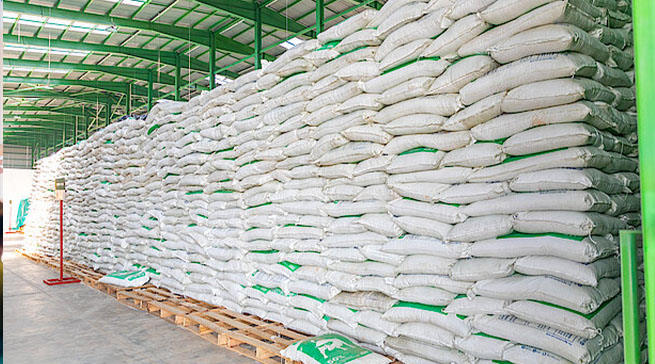
Rwanda has assured farmers that fertiliser supplies for the 2027A planting season are secured, despite disruptions in international supply chains caused by geopolitical conflicts.
Agriculture and Animal Resources Minister Dr Telesphore Ndabamenye said the country will need about 61,000 tonnes of fertiliser for the season, which is expected to begin in mid-September, with more than half of the required quantity already available.
“We already have more than 50% of what we will need for this season.”
The assurance comes as Rwanda seeks to protect farmers from potential shortages and supply disruptions while increasing domestic fertiliser production.
Ndabamenye said about 25,000 tonnes of the fertiliser required for the season will be produced locally, while the remainder will be sourced from international markets. He said the government is closely monitoring imports to ensure global disruptions do not affect farmers.
Rwanda has been increasing its domestic fertiliser-blending capacity as part of efforts to reduce dependence on imports. The fertiliser blending plant operated by Rwanda Fertilizer Company in Bugesera has an annual capacity of 100,000 tonnes, allowing the country to produce blends tailored to local soil conditions.
For the 2027A season, about 40% of Rwanda’s fertiliser requirement is expected to come from domestic production, according to MINAGRI.
The government is also promoting locally formulated fertilisers, including Twihaze and Ongera, developed using research on Rwanda’s soil conditions. Twihaze, for example, contains calcium to help address soil acidity, a major challenge affecting agricultural productivity in parts of the country.
The locally formulated products are part of a broader shift towards fertilisers designed to match the nutrient requirements of specific soils and crops.
Subsidies to cushion farmers
Alongside efforts to secure supplies, the government will continue subsidising fertiliser purchases for farmers during the 2027A season.
DAP will receive a 46% subsidy, while UREA will be subsidised at 45%. NPK 17-17-17 will receive a 43% subsidy, Kynoplus coated urea 45%, KCL/MOP 36%, and micronutrient fertilisers and blends 18%.
The subsidies are intended to cushion farmers from higher international input costs. The government previously attributed rising fertiliser prices to global market pressures, higher transport costs and geopolitical disruptions.
The government has also prepared more than 10,000 tonnes of agricultural lime and about 6,000 tonnes of improved seed for the coming season, with the inputs to be distributed under government support programmes.
Improved seeds for maize, soybeans and wheat will also receive government support, as Rwanda seeks to increase productivity and strengthen food security.
Farmers urged to prepare early
With the planting season approaching, Ndabamenye urged farmers to begin preparing their fields early so they can plant promptly when the rains arrive.
He also called on farmers to make full use of land available for cultivation, particularly agricultural sites targeted by the government to increase productivity.
The minister said the government is placing particular emphasis on Ibyanya Bigega sites, which cover nearly 600,000 hectares across the country.
The government wants to significantly increase yields from these sites, with a target of potentially nearly doubling production per hectare.
Rwanda’s strategy of increasing local fertiliser production is expected to help reduce exposure to international supply shocks while ensuring farmers have access to inputs adapted to the country’s diverse soil conditions.