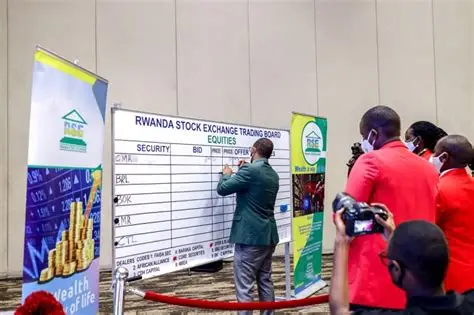
Rwanda’s capital market has been ranked seventh in Africa after its overall index rose by 44% since the beginning of 2026, while its value increased by 46% over the past year.
Economic analysts say the growth is a significant development for Rwanda’s financial sector, although they note that public participation in buying shares and government securities remains relatively low compared with countries ahead of Rwanda in the ranking.
The Rwanda Stock Exchange has continued to expand, with its overall market index recording a 44% increase since the start of the year and a 46% rise over the past 12 months.
Pierre Celestin Rwabukumba, Chief Executive Officer of the Rwanda Stock Exchange, attributed the increase to the rising value of shares traded on the market.
He explained that the market index provides an indication of how much share prices have increased over a given period, meaning that an index level of 260, for example, would indicate that the value has grown to 2.6 times its base level.
Despite the strong performance, experts say participation by ordinary citizens in the capital market remains limited compared with countries ranked ahead of Rwanda, including Nigeria, Zimbabwe, Tanzania, Ghana, Côte d’Ivoire and Uganda.
Economist Prof. Ruranga Egide said limited public understanding of how the capital market works is one of the factors affecting participation.
He noted that many people still lack sufficient information about investment opportunities available through the stock market.
Soraya Hakuziyaremye, Governor of the National Bank of Rwanda, said the capital market plays an important role in the country’s economic development, particularly by providing access to long-term financing.
“While banks provide medium-term loans, capital markets mobilise long-term funds that can be invested in sustainable economic development,” Hakuziyaremye said. “These markets also contribute to innovation, infrastructure development and the expansion of private-sector growth.”
She said strengthening the capital market is particularly important for Rwanda as the country pursues long-term and sustainable economic development.
“For a country like Rwanda that is committed to sustainable development, strengthening the capital market is not an option but a necessity,” she said. “The progress we celebrate today is the result of sound policy decisions and strong collaboration across different sectors.”
The total value of securities listed on Rwanda’s capital market currently stands at about 30% of the country’s gross domestic product.
Equities traded on the market are valued at approximately $4.5 billion, equivalent to 28% of GDP, while government securities are valued at about $1.5 billion, representing around 9% of GDP.
Analysts say continued growth of the capital market will depend partly on increasing public participation in investments in shares and government securities, which could further deepen the market and strengthen its contribution to Rwanda’s economic development.