Rwanda has urged the United Nations Security Council to prioritise efforts to eliminate the Democratic Forces for the Liberation of Rwanda (FDLR), an armed group operating in eastern Democratic Republic of Congo (DRC), saying its continued presence remains a security concern for Rwanda and the wider region.
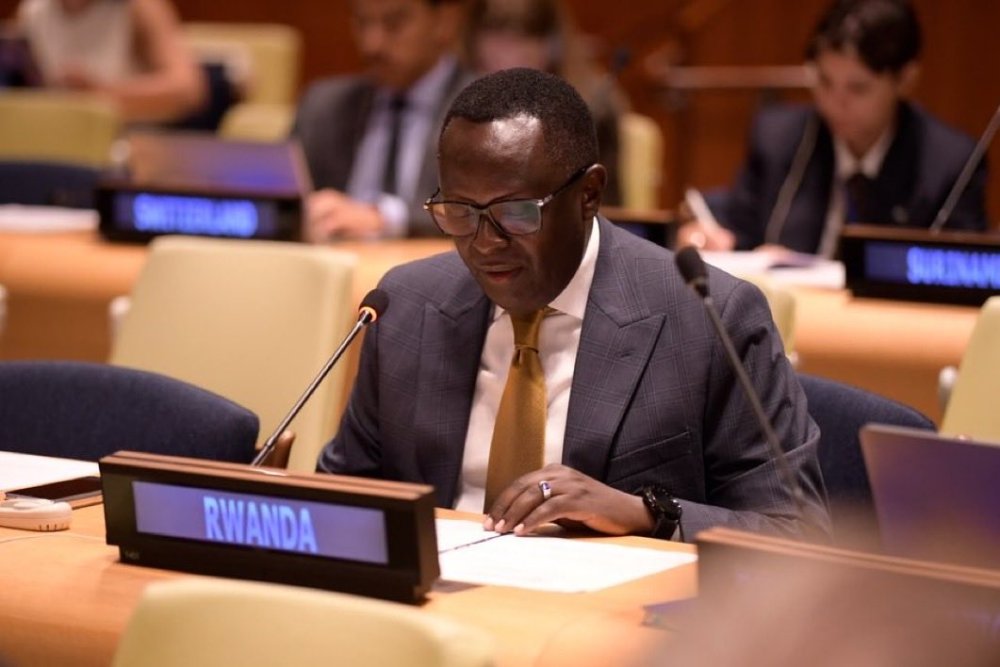
Rwanda’s Permanent Representative to the United Nations, Martin Ngoga, made the call on September 29, 2026, during a Security Council meeting convened by France to discuss the situation in eastern DRC and the activities of the UN peacekeeping mission MONUSCO.
The meeting took place as the UN continues to follow the implementation of peace initiatives under the Washington and Doha agreements, which seek to address the conflict in eastern DRC and support a political path towards lasting peace.
Ngoga said the FDLR should not be treated as a distant issue because of its reported proximity to Rwanda’s border, military capacity and alleged cooperation with other armed groups.
He said Rwanda had taken steps to remove its defensive measures as required under the Washington agreement, but argued that eliminating the FDLR remained one of the key commitments that must be implemented for sustainable peace in the Great Lakes region.
“Rwanda has taken the decision to remove its defensive measures and has communicated these steps through the mechanisms established under the Washington agreement,” Ngoga said. “We have requested the establishment of a tripartite verification mechanism involving Rwanda, the DRC and the United States.”
Rwanda said it welcomed the mediation efforts led by the United States and Qatar and would continue to honour its commitments under the Washington agreement.
Ngoga also referred to the Joint Security Coordination Mechanism (JSCM), established to monitor the implementation of commitments under the peace process, including the elimination of the FDLR and the removal of Rwanda’s defensive measures.
According to Ngoga, Rwanda has already made progress in removing those measures and has communicated the steps to the bodies responsible for monitoring implementation. However, he said gaps remain, particularly regarding the commitments related to the FDLR.
Rwanda also raised allegations of continued cooperation between the Congolese armed forces, FARDC, the FDLR, Wazalendo and other armed groups.
Ngoga cited several incidents in 2026 that Rwanda says involved the movement of military supplies to areas where armed groups operate. He referred to reported movements in February, March, April, June, July and August, including incidents around Pinga, Kibua, Ntoto and Walungu.
The claims were presented by Rwanda as evidence that commitments concerning support to armed groups have not been fully implemented.
Rwanda also opposed addressing the FDLR issue through separate negotiations or agreements between the DRC government and the armed group, arguing that such approaches should not replace commitments made under the Washington agreement.
Ngoga said both the Washington and Doha agreements should be implemented by all parties and that each side should be held accountable for the commitments it has made.
He also raised concerns about the reported reinstatement of FARDC spokesperson Maj. Gen. Sylvain Ekenge, linking the matter to remarks previously attributed to the military official concerning Kinyarwanda-speaking Congolese and Tutsi communities.
Ngoga argued that the reported return to the position raised concerns about how hate speech and inflammatory rhetoric are addressed.
The Security Council meeting also focused on the broader peace process in eastern DRC, with the UN urging the parties to honour their commitments under the Washington and Doha frameworks and continue political efforts aimed at ending the fighting.
For Rwanda, the elimination of the FDLR remains a central issue in the implementation of the Washington agreement. Kigali maintains that addressing the armed group, alongside fulfilling other commitments by all parties, is necessary for achieving lasting peace and security in the Great Lakes region.