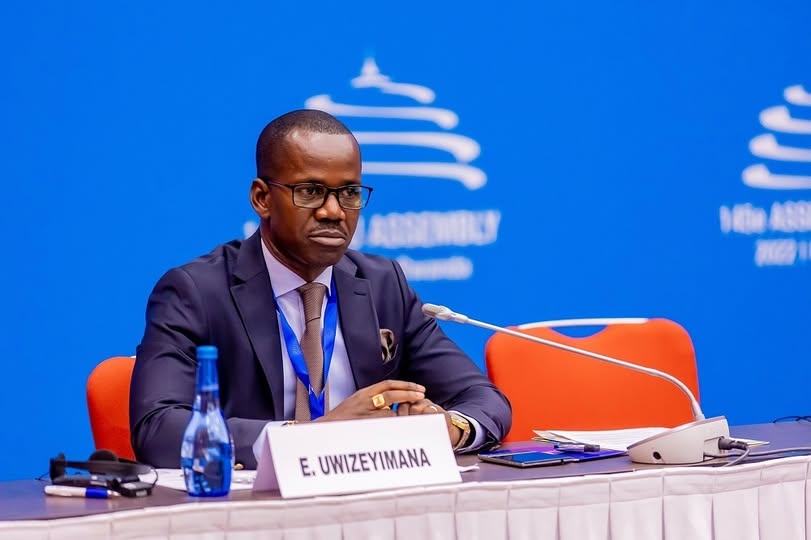
Rwandan Senator Evode Uwizeyimana has compared the political and military challenges facing Democratic Republic of Congo (DRC) President Félix Tshisekedi to those that confronted former Rwandan President Juvénal Habyarimana during his time in power.
He made the remarks on October 18, 2026, during an interview with Rwanda Broadcasting Agency (RBA) discussing the implications of the creation of the Front de Résistance Nationale (FRN), a movement established by former DRC president Joseph Kabila on October 12, 2026.
The new movement opposes Tshisekedi’s government and follows the emergence of the AFC/M23 alliance, as the conflict in eastern DRC continues to pose a major challenge to the authorities in Kinshasa.
Uwizeyimana said Tshisekedi’s initial reluctance to negotiate with AFC/M23, which his government regarded as a rebel movement, before eventually accepting talks, resembled the pressure Habyarimana faced from the Rwandan Patriotic Front’s armed wing, the Rwandan Patriotic Army (RPA).
“When someone has greater military strength than you, they will use that strength to take what you are unwilling to give them. Tshisekedi was being told: these people are militarily stronger than you, so agree to negotiate with them,” he said.
The senator also highlighted Article 64 of the DRC’s 2006 Constitution as a potential source of further political controversy.
The provision gives Congolese citizens the right to resist any individual or group that seizes power or exercises it in violation of the Constitution.
Uwizeyimana suggested Kabila could invoke the article to justify the establishment of the FRN, amid political disagreements within the DRC government over several issues, including a proposed constitutional amendment.
He warned that Tshisekedi could face mounting domestic political pressure while the conflict in eastern DRC remains unresolved.
“Tshisekedi has created another war in Kinshasa while he is still struggling with the other battle in the east, which he has failed to win,” he said.
On the DRC’s minerals agreement with the United States, Uwizeyimana argued that Kinshasa may have expected Washington to provide more military assistance than it is prepared to offer.
He said the agreement was unlikely to result in American troops being deployed to fight M23, suggesting that US support could instead take the form of other measures, including sanctions.
“That agreement does not give the DRC much in return, perhaps around 30 per cent. It was essentially a commitment to provide minerals in exchange for assistance with security. American troops will not come to fight in the DRC; perhaps the Americans will take measures such as the sanctions they have been talking about,” he said.