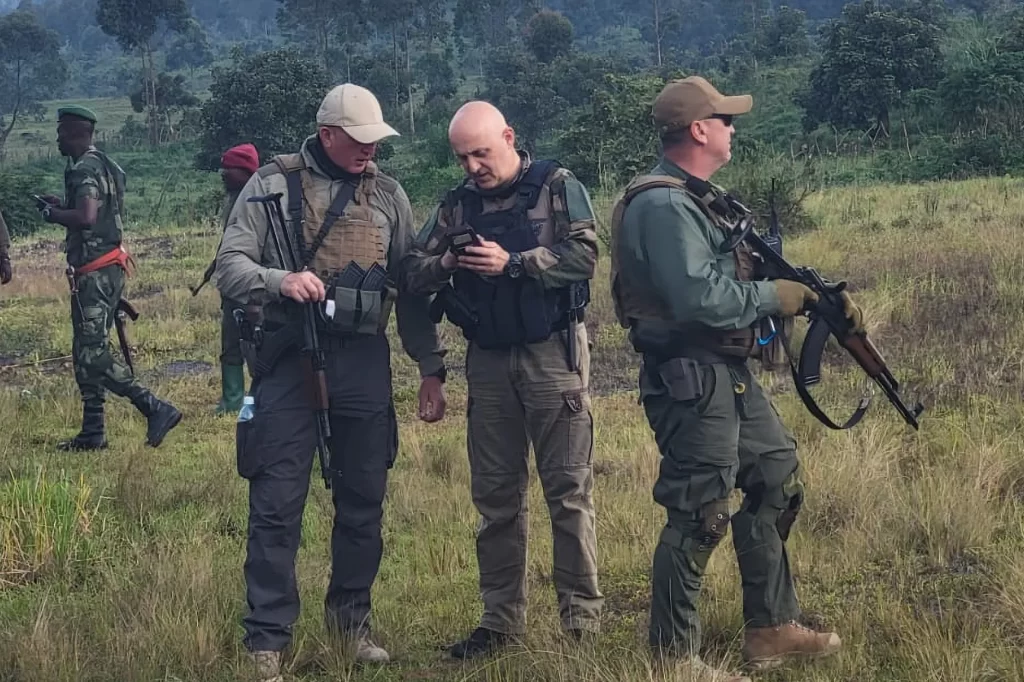
Horatiu Potra, the former commander of a group of Romanian mercenaries hired by the Democratic Republic of Congo (DRC), says the AFC/M23 rebel group would have captured Goma even if his men had stayed in the city. He blamed shortcomings in the Congolese military’s leadership and operations for its defeat.
In an exclusive interview with RNA News, Potra explained why his group left Goma as AFC/M23 advanced on the city in late January 2025.
He said his men had been hired to train Congolese soldiers and protect their positions, rather than take part in every battle unfolding across the city.
Potra rejected claims that the mercenaries’ departure led to Goma’s capture, arguing that the Armed Forces of the Democratic Republic of the Congo (FARDC) already faced serious operational challenges.
“Goma was not captured because we left. Whether we had stayed or not, it would have been captured anyway,” he said.
He explained that his group decided to move towards the bases of the United Nations Organization Stabilization Mission in the Democratic Republic of the Congo (MONUSCO) after Congolese troops began abandoning their positions and the mercenaries’ own location came under attack.
According to Potra, the withdrawal was intended to prevent his men from being surrounded by advancing forces and reduce the risk of further fighting in densely populated civilian areas.
Congolese soldiers were not adequately supported
Potra said FARDC’s failure to defend Goma was not simply a battlefield problem but also reflected shortcomings in soldiers’ welfare, equipment and military leadership.
He said he had proposed at least doubling the salaries of soldiers deployed to the front line to improve their motivation, but the recommendation was never implemented.
He also alleged that some soldiers spent months at military positions without adequate food and equipment, forcing some to sell or exchange their belongings to obtain basic necessities.
“Some soldiers spent months on the front line without adequate equipment, and some even sold what they had to get food,” he said.
Potra added that keeping soldiers in combat zones for extended periods without leave to visit their families also affected morale.
He said he had proposed a troop rotation system, under which soldiers would be replaced after a specified period. He also suggested making greater use of soldiers from areas experiencing fighting to improve military operations.
M23 had advanced military equipment
Potra said AFC/M23 and its allies demonstrated their military strength through their operational organisation and the technology they used.
He cited equipment including GPS-guided munitions, missiles, air-defence systems and technology capable of disrupting military communications.
He argued that these capabilities enabled M23 to sustain its attacks while FARDC struggled with operational and preparedness problems.
Potra presented these observations as his assessment of the factors behind the Congolese army’s defeat, while acknowledging that they might not fully explain Goma’s capture.
Denies links to M23 and Wagner
Potra also denied allegations that he had worked with Russia’s Wagner Group or held contacts with AFC/M23 leaders before Goma fell.
Asked about Wagner, he said: “No, never. […] I have never met a single person from Wagner.”
He said his group comprised former Romanian and Moldovan soldiers who had served with the French Foreign Legion, adding that no Russians or Ukrainians were part of his contingent in Goma.
Potra also rejected claims that he had reached an agreement with AFC/M23 or received money to persuade his men to leave the DRC.
“That is not true. As far as M23 is concerned, I never held discussions with anyone before the events in Goma and crossing the border into Rwanda,” he said.
Regarding their reception in Rwanda, Potra said the authorities treated them well and that no financial negotiations took place.
Calls for a negotiated solution in the DRC
Reflecting on the security situation in the Great Lakes region, particularly eastern DRC, Potra said economic interests and the distribution of natural resources played a role in fuelling conflict.
He argued that countries and their partners should prioritise cooperation that delivers benefits to all parties rather than arrangements that serve only one side.
“In any relationship or partnership, each side must see a benefit in it to prevent conflict,” he said.
He added that dialogue was essential to finding a lasting solution to insecurity in the DRC, although reaching an agreement could prove difficult.
AFC/M23 captured Goma on January 27, 2025, following intense fighting in surrounding areas. The takeover was followed by the departure of Romanian mercenaries hired by the Congolese government. They moved to MONUSCO positions before being transferred through Rwanda.