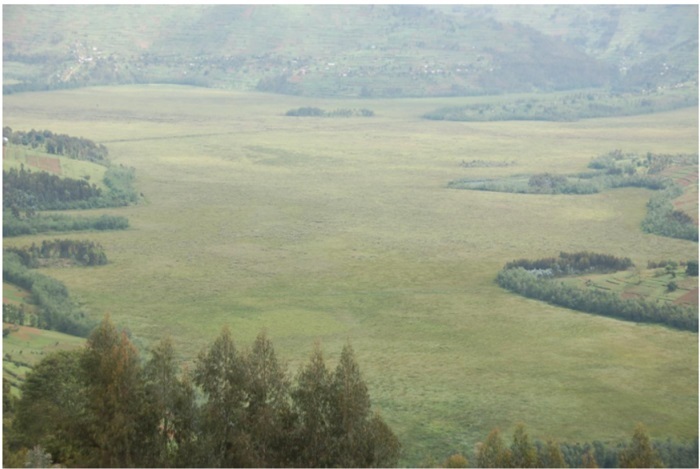
Farmers cultivating the Bimera wetland in Ngoma Sector, Nyaruguru District, say their harvests have more than doubled following the rehabilitation of the wetland and the construction of radical terraces on surrounding hillsides, which have helped control soil erosion and protect farmland.
Members of ABATICA UMUGAMBI Cooperative said that before the rehabilitation, runoff from surrounding hillsides frequently washed through their fields, destroying crops and degrading the soil, resulting in poor harvests.
Mukagatare Velda, a farmer in the wetland, said the combined efforts to rehabilitate the wetland and construct radical terraces had significantly improved agricultural production.
“Before the wetland was rehabilitated, production was poor because soil erosion from the hillsides destroyed fields in the valley and washed away our crops, leaving us with losses. Now, erosion has been controlled through radical terracing on the hillsides, which helps contain runoff that previously damaged the wetland,” she said.
She said yields have increased from about two tonnes per hectare before the interventions to 4.5 tonnes per hectare.
Mukagatare added that the improved harvests have also helped farmers improve their livelihoods. Through their cooperative, they pool their produce, access reliable markets and earn income to meet their household needs.
The benefits extend beyond crop production in the wetland, she said, as farmers also grow fodder on the terraces, which supports livestock farming and provides another source of income when sold.
Rodrigue Twahirwa, an agriculture and natural resources officer in Ngoma Sector, said the wetland rehabilitation and hillside terracing were implemented together to protect the land and improve agricultural productivity.
“The results are evident. The construction of terraces on the hillsides and the rehabilitation of the wetland complemented each other. Protecting the hillsides helps control runoff and prevent water from flowing down and damaging the wetland, while rehabilitating the wetland ensures it is properly managed for productive farming,” he said.
Twahirwa urged farmers to maintain the infrastructure, including radical terraces, by planting agroforestry trees to strengthen soil protection and sustain productivity.
He also encouraged them to regularly clear drainage channels to ensure that rainwater and runoff are properly channelled without damaging the rehabilitated infrastructure.
He said farmers previously cultivated their land without proper coordination, but combining soil conservation measures, wetland rehabilitation and the use of agricultural inputs had contributed to higher yields.
For crops grown on hillsides, production has increased from 3.2 tonnes per hectare to 5.6 tonnes per hectare, he said.
Potato yields in the wetland have also increased by 25 tonnes per hectare compared with previous harvests, when farmers typically obtained between eight and 12 tonnes per hectare.
The Bimera wetland covers 53 hectares, while more than 120 hectares of radical terraces have been constructed across Ngoma Sector.