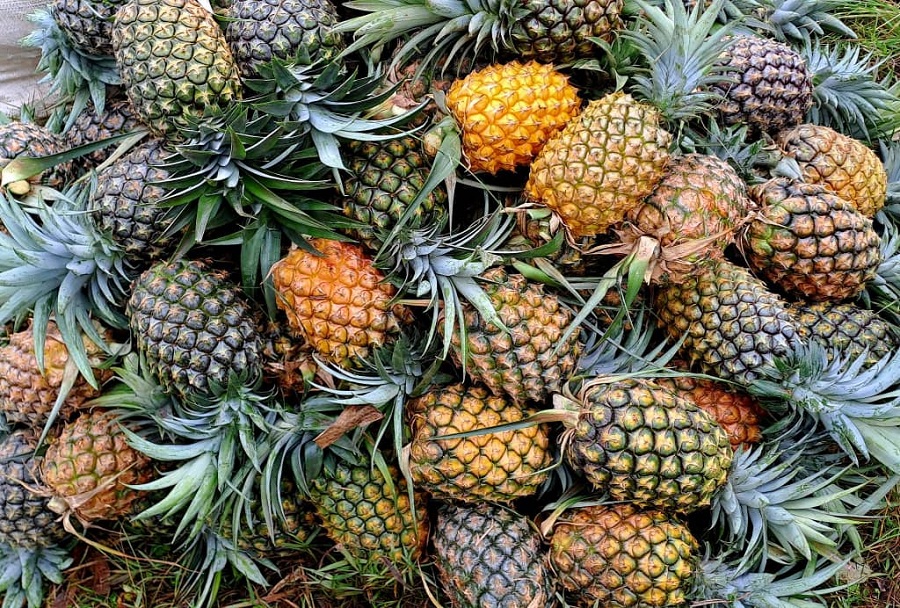
Pineapple and banana farmers in Rwanda are facing persistent challenges in finding reliable markets for their produce, with some forced to sell below production costs while others struggle to find buyers altogether.
Farmers say the lack of dependable markets is affecting their livelihoods, particularly during periods of high production when they cannot secure buyers willing to offer profitable prices.
Ndayishimiye Noel, a pineapple farmer in Rusizi District, said farmers do not have established markets and are forced to find buyers individually, leaving them vulnerable to low prices.
“We do not have a reliable market. Everyone sells independently, and it is difficult. When pineapples are in large supply, buyers lower their prices. A pineapple that used to sell for RWF 1,000 can go for as little as RWF 300,” he said.
Ndatimana Protogene, another pineapple farmer in Ruhango District, said they usually harvest their produce and take it to ordinary markets, where they sell to whoever is willing to buy.
“We harvest and take the pineapples to the local markets, where we sell directly to consumers or anyone we find willing to buy. In short, we do not have a reliable market,” he said.
Similar challenges are affecting banana farmers, particularly those growing varieties used in the production of beverages.
During nationwide visits to assess how different agricultural products are processed and marketed, Members of Parliament found that some banana farmers had been left without buyers following the closure of several beverage processing factories.
MP Christine Mukabunani said some farmers had been encouraged to grow bananas after being promised markets through government-approved processing factories. Many invested heavily in the crop, only to suffer losses when the factories were closed.
She noted that some farmers are now struggling to repay loans, with others facing the possibility of having their property auctioned by banks.
MP Damien Nyabyenda argued that farmers should not be held responsible for problems arising from the production and consumption of substandard beverages, especially since many depended on banana farming to support their families.
MP Jean Claude Mazimpaka also pointed out that certain banana varieties are not suitable for direct consumption or making traditional banana dishes but are mainly grown for juice and alcoholic beverage production.
He stressed that a lasting solution was needed to address the market challenges, warning that production would continue to increase without a corresponding market.
The government says it is working on new regulations governing beverage processing factories to improve their operations while safeguarding public health.
The Minister of Trade and Industry, Antoine Kajangwe, told MPs that the government was reviewing regulations for factories producing both alcoholic and non-alcoholic beverages to ensure they meet quality standards and are subject to proper inspection.
Kajangwe added that the government plans to allow private companies to provide some quality assurance services as part of efforts to strengthen the inspection of beverage processing facilities.
The issue has resurfaced following the closure of more than 130 alcoholic beverage factories by the Rwanda Food and Drugs Authority (Rwanda FDA) in August 2026. Their operating licences were revoked after inspections found that their products did not meet required quality standards and could pose risks to public health.
While the government maintains that protecting public health remains its priority, farmers are calling for solutions that will help them secure reliable markets for their bananas and pineapples, ensuring that their harvests do not go to waste.