Microsoft co-founder and philanthropist Bill Gates says his recent visit to Rwanda reinforced his belief that long-term investment in people, strong institutions and technology can drive meaningful national transformation.
Gates, who is also the co-chair of the Gates Foundation, spent a week in Rwanda exploring the country’s progress in healthcare, technology, education and innovation, while meeting government officials, entrepreneurs, researchers and other stakeholders involved in shaping Africa’s future.
Reflecting on his visit, Gates said Rwanda offered reasons for optimism about the continent’s future.
“I’ve just had a wonderful week in Rwanda. The trips I value most are those that leave me feeling energized and hopeful. If you are looking for reasons to be optimistic about the future, Rwanda is a great place to start,” he said.
He said one of the key lessons from Rwanda was the impact of sustained investment in citizens and national institutions.
“What impressed me most is how Rwanda has invested in its people, built strong institutions and created tangible progress,” Gates said.
He pointed to improvements in healthcare over the past two decades, including a significant reduction in child and maternal deaths.
According to Gates, since 2000, deaths among children under five have declined by 73 percent, while maternal deaths have fallen by more than 80 percent. He also noted that nearly all pregnant women in Rwanda now give birth in health facilities supported by trained health professionals.
Gates also praised the role of Rwanda’s leaders, innovators and institutions in advancing development priorities.
“Africa is entering a new era led by Africans themselves, and seeing that firsthand has been inspiring,” he said.
He added that the Gates Foundation’s role is to support leaders and innovators by providing resources, knowledge and technical expertise to help maximize the impact of investments aimed at improving lives.
Technology and innovation shaping Rwanda’s future
During his visit, Gates met young entrepreneurs and technology innovators using artificial intelligence and digital solutions to address challenges affecting communities.
He said he was impressed not only by the technologies being developed but also by the ambition and creativity of young Africans building solutions for local challenges.
At the National Health Intelligence Center (NHIC), Gates observed how Rwanda uses digital systems to collect and analyze health information from community health workers, health centres and hospitals to support evidence-based decisions.
He said Rwanda’s approach demonstrates the value of using reliable data to improve healthcare services.
Gates also visited the Horizon 1000 initiative, which applies artificial intelligence to strengthen primary healthcare. He noted that the project had moved beyond concept development and was already being tested in practice.
Community health workers remain central to healthcare delivery
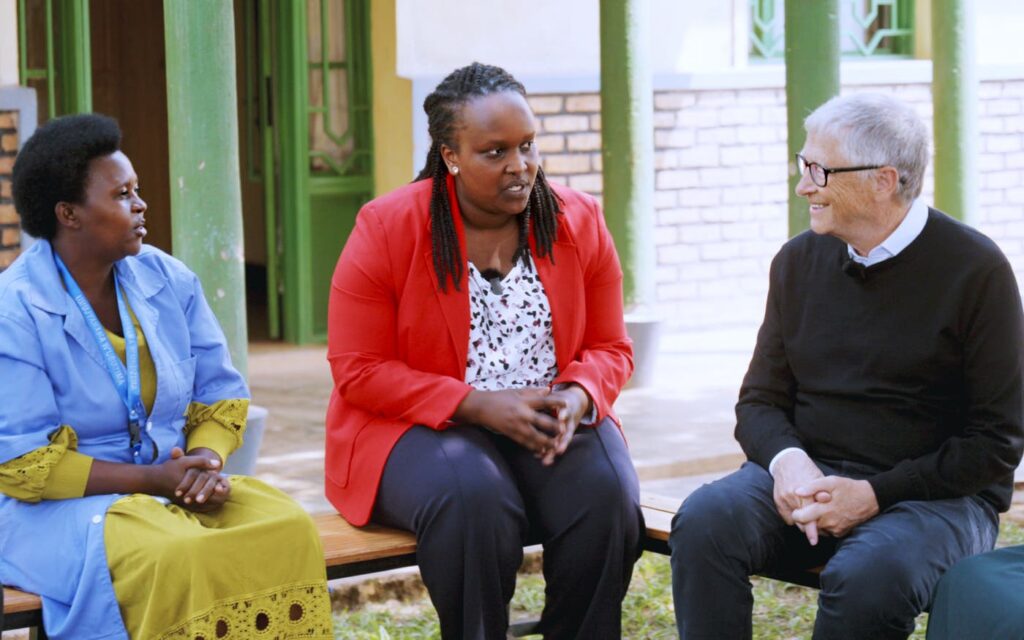
In Mwulire Sector, Gates accompanied community health worker Gaudence Ngendahayo during routine field activities, observing how community health workers visit households, provide basic care, refer patients needing additional services and collect information used by health authorities.
He described community health workers as a foundation of Rwanda’s healthcare system.
Local solutions for local challenges
Gates also visited TKMD, a Rwandan company manufacturing single-use medical syringes. He said producing essential medical supplies locally can strengthen healthcare resilience and reduce reliance on imports.
At Carnegie Mellon University Africa’s Upanzi Digital Experience Center, he learned about digital innovations developed by African students and researchers.
He said such initiatives demonstrate the potential of African-built solutions to address challenges on the continent and beyond.
Gates’ visit comes as Rwanda continues to position technology, innovation and human capital development as key drivers of its long-term development strategy.