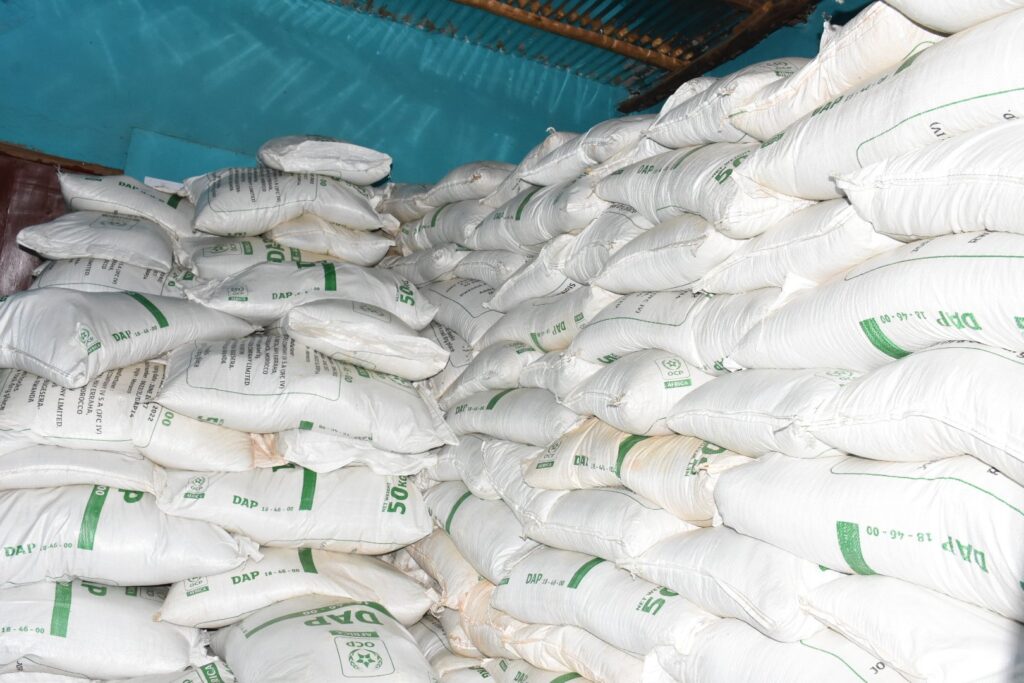
The Rwandan government has announced additional support for farmers after global fertilizer prices surged by as much as 66% in just four months, a spike largely driven by ongoing conflicts in the Middle East and Ukraine.
Prime Minister Dr. Justin Nsengiyumva said the wars have disrupted global supply chains, causing international fertilizer prices to rise by between 15% and 66% over the past four months.
Speaking before a joint sitting of Parliament during a presentation on the government’s measures to safeguard the economy and citizens’ welfare, Dr. Nsengiyumva said the government is expanding fertilizer subsidies to shield farmers from the sharp price increases.
“To cushion farmers from these price hikes, the Government has decided to cover 50% of the increase in fertilizer prices, in addition to the subsidy already in place,” he said.
The increased support will push government spending on fertilizer subsidies to more than Rwf64 billion in the 2026/27 fiscal year, up from over Rwf39 billion in 2025/26. The additional allocation of more than Rwf25 billion represents a 64% increase in subsidy funding.
According to the Prime Minister, the enhanced subsidy is expected to keep fertilizer affordable while encouraging greater use among farmers.
He noted that fertilizer application has already increased from 73 kilograms per hectare in 2024 to 80 kilograms per hectare this year, with the government targeting 94.6 kilograms per hectare by 2029.
The announcement follows the Ministry of Agriculture’s release of revised fertilizer prices and its call for farmers to submit their fertilizer requirements early to facilitate procurement and distribution.
Under the new pricing structure, the price of Urea fertilizer has increased from Rwf1,190 to Rwf1,980 per kilogram, a 66% rise. NPK 17-17-17 (Compound) has gone up from Rwf1,369 to Rwf1,861 per kilogram, representing a 36% increase, while NPK 17-17-17 (Blend) has risen from Rwf1,330 to Rwf1,780 per kilogram, an increase of 34%.
To reduce reliance on imported fertilizers and lower procurement costs, Dr. Nsengiyumva said Rwanda has established a fertilizer blending plant with the capacity to produce 100,000 tonnes annually.
He added that the government will maintain tax exemptions on veterinary medicines and essential agricultural equipment, including tractors, irrigation systems and water-harvesting technologies, to ease production costs for farmers and livestock keepers.
The government is also investing in post-harvest infrastructure to reduce crop losses. In collaboration with the private sector, it is expanding facilities such as drying grounds, warehouses, cold storage facilities and crop dryers to improve produce handling and preservation.
To strengthen resilience against climate change and erratic rainfall, irrigated farmland has expanded to more than 76,000 hectares, with plans to exceed 82,000 hectares this year.
The government aims to increase the country’s irrigated area to more than 132,000 hectares by 2029, while continuing to invest in modern weather forecasting technologies to provide farmers and other stakeholders with timely and reliable climate information for better planning.