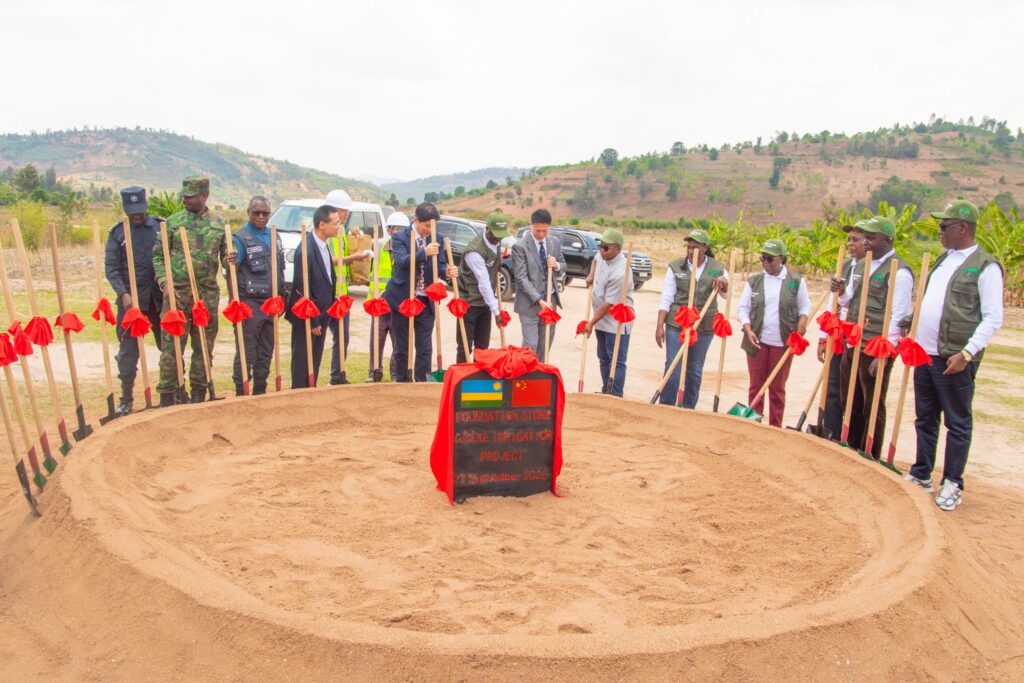
Farmers in Gisagara District expect the Giseke irrigation dam to help expand the area under cultivation and increase agricultural productivity to as much as seven tonnes per hectare by providing a more reliable water supply.
The project is being implemented by the Government of Rwanda in partnership with China at a cost of $47 million. The dam will have a reservoir with a storage capacity of 6.5 million cubic metres of water and is expected to provide irrigation for more than 2,600 hectares of farmland.
The irrigation infrastructure will serve farmers cultivating crops in both marshlands and on hillsides across six sectors of Gisagara District, including Save, Musha and Ndora.
Farmers in the area say limited access to water during dry periods has constrained agricultural production, with some crops drying up or failing to mature properly.
One farmer told Rwanda Broadcasting Agency (RBA) that he owns 182 hectares of land but currently cultivates only 145 hectares because of water shortages.
“We did not produce as much as we wanted. But with this project coming, we expect to harvest at least seven tonnes per hectare,” he said.
The project is therefore expected to enable farmers to make greater use of available land while reducing their dependence on rainfall.
Irrigation to support climate resilience
Minister of Agriculture and Animal Resources Dr Thelesphore Ndabamenye said the Giseke project will incorporate technology to support more efficient and modern farming, particularly among farmers who have traditionally depended on rainfall.
He said reliable access to irrigation is becoming increasingly important as climate change affects rainfall patterns and agricultural production.
“There are issues of income in general, as well as ensuring sufficient food. We are particularly dealing with the effects of climate change, and it is clear that people in this area still have not received adequate rainfall,” Ndabamenye said.
He said the project would help farmers respond to changing weather conditions and reduce the impact of unreliable rainfall on agricultural production.
The minister also linked water shortages to low rice productivity in the area, saying the irrigation project would help address the challenge for rice farmers while extending irrigation to hillside fields.
“We saw that the rice farmers here were not getting high yields because of limited water. We hope the water challenge for those cultivating rice will be addressed, while farmers on the hillsides will also benefit depending on the terrain,” he said.
Farmers growing other crops are also expected to benefit from water-efficient irrigation technologies, allowing them to maintain production during periods of insufficient rainfall.
China partnership backs agricultural infrastructure
The Giseke project is part of Rwanda’s cooperation with China in the development of agricultural infrastructure.
Chinese Ambassador to Rwanda Gao Wenqi described the project as an example of the bilateral relationship between the two countries and their broader cooperation with Africa.
“The Giseke project is an important project reflecting the good relationship between Rwanda and China, as well as the good relations between China and Africa. It is expected to reduce poverty and promote agriculture that improves people’s livelihoods,” Gao said.
The wider project also includes road-related works, with the infrastructure component covering about 560,000 hectares, according to information presented during the project’s implementation.
For farmers in Gisagara, the irrigation investment is expected to create greater opportunities for commercial agriculture by increasing the amount of land that can be cultivated, improving productivity and making farming less vulnerable to rainfall shortages.