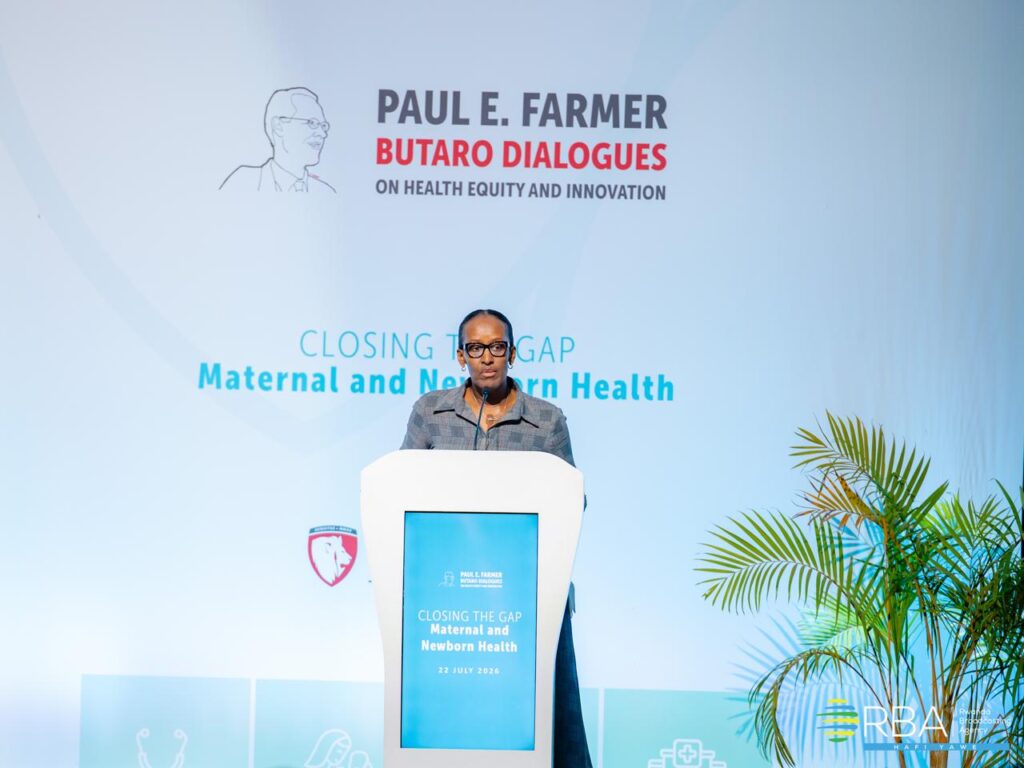
First Lady Jeannette Kagame has urged researchers, health leaders, policymakers and development partners to move beyond generating knowledge and focus on transforming health research and innovations into practical solutions that can save the lives of mothers and children.
She made the call during the Paul E. Farmer Butaro Dialogues held at the University of Global Health Equity (UGHE) in Butaro, Burera District. The forum brought together health experts, researchers, policymakers, students and community health workers to discuss ways of addressing remaining challenges in maternal and child healthcare.
Jeannette Kagame said the world’s biggest challenge is no longer the absence of solutions to reduce maternal and child deaths, but ensuring that proven solutions are effectively implemented and reach every community.
“The issue we face today is one of implementation. It is about taking solutions that have already proven to work and making sure they reach every woman, wherever she lives,” she said.
She emphasised the need to strengthen the connection between research, innovation and policymaking, saying health equity must begin at the community level. She also called for greater involvement of community health workers and students in decision-making, noting that their experience is essential in designing effective healthcare systems.
The First Lady commended Bill Gates for his contribution to expanding access to healthcare worldwide and for supporting the legacy of Dr Paul Farmer, the late co-founder of UGHE, whose work promoted the belief that everyone deserves equal access to quality healthcare.
“Health equity begins where people live. The trust that a health worker builds in one household should become a standard across the entire country,” she said.
She highlighted Rwanda’s progress in improving maternal and child health as evidence that sustainable healthcare improvements are possible when governments set clear priorities, institutions work together and communities are involved.
Over the past three decades, Rwanda has significantly reduced maternal and child mortality rates. Jeannette Kagame attributed the progress to combining research with implementation, strong political commitment, investment in primary healthcare and the expansion of community health programmes.
Looking ahead, she called for increased investment in primary healthcare, stronger community-based services, greater use of technology in health education and training, and expanded partnerships between African countries and global health stakeholders.
She also urged greater support for youth-led innovations, saying young innovators should not only be recognised but also provided with the resources, opportunities and trust needed to expand their impact.
Jeannette Kagame described maternal and child deaths as more than a health issue, saying they represent a broader challenge linked to human values and society’s responsibility to protect life.
“When a woman dies while giving life, it is a painful sign that somewhere the health system failed to provide what was possible,” she said.
She expressed hope for a future where no woman fears losing her life during pregnancy or childbirth, but instead experiences motherhood with confidence, safety and dignity.
The Paul E. Farmer Butaro Dialogues were organised by UGHE in partnership with the Consortium of Medical Schools-Africa (COMS-A), focusing on accelerating solutions that improve maternal and newborn health outcomes.