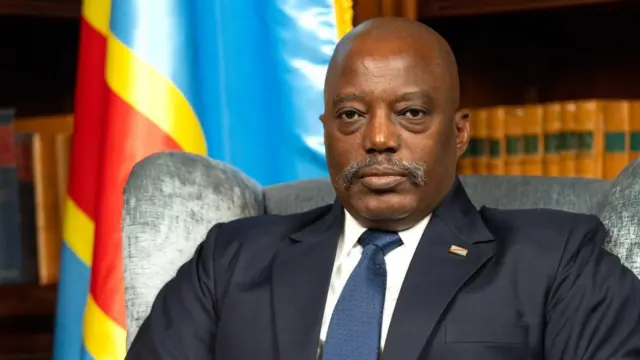
Rwanda’s Minister of Foreign Affairs and International Cooperation, Olivier Nduhungirehe, has dismissed allegations by the Democratic Republic of Congo (DRC) that former President Joseph Kabila is working to undermine Félix Tshisekedi’s government with Rwanda’s support, describing him instead as a politician who has been persecuted by the authorities in Kinshasa.
Nduhungirehe made the remarks during an interview with France 24, arguing that Kabila had been politically isolated by Tshisekedi’s administration and was therefore entitled to form alliances with other Congolese politicians.
“President Joseph Kabila had been sidelined. He had no other option. His decision to join forces with other Congolese politicians was understandable. He is not Rwanda’s proxy,” Nduhungirehe stated.
The minister accused Tshisekedi’s government of placing Kabila under severe pressure, forcing him into exile and even attempting to kill him.
He also referred to an attack in Goma in March that killed French UNICEF staff member Karine Buisset, alleging that Kabila was among the intended targets.
Nduhungirehe further criticised the sanctions imposed on Kabila by the United States, arguing that they had been introduced at Kinshasa’s request.
He maintained that the political and security challenges facing the DRC should be addressed through dialogue among Congolese themselves, rather than being taken to the international stage in search of people to blame.
The minister also addressed remarks by DRC Environment Minister Eve Bazaiba, who attributed food insecurity affecting 28 million Congolese to what she described as Rwanda’s war of aggression against the DRC.
In a post on X, Nduhungirehe challenged the allegations, questioning whether Rwanda could reasonably be blamed for hunger affecting communities across such a vast country.
“Twenty-eight million Congolese, from Haut-Katanga to Nord-Ubangi, and from Kongo-Central to Haut-Uele, need urgent assistance. Is all of this caused by Rwanda? It is easy to see that this narrative is simply intended to distract people,” he wrote.
Rather than attributing all the country’s challenges to Rwanda, Nduhungirehe urged the Kinshasa government to address domestic problems, including weak state institutions, corruption, inadequate basic infrastructure and limited control over national territory.
He argued that continually looking outside the country for explanations for its problems would not deliver lasting solutions, emphasising that dialogue and governance reforms were essential to achieving sustainable peace in the DRC.