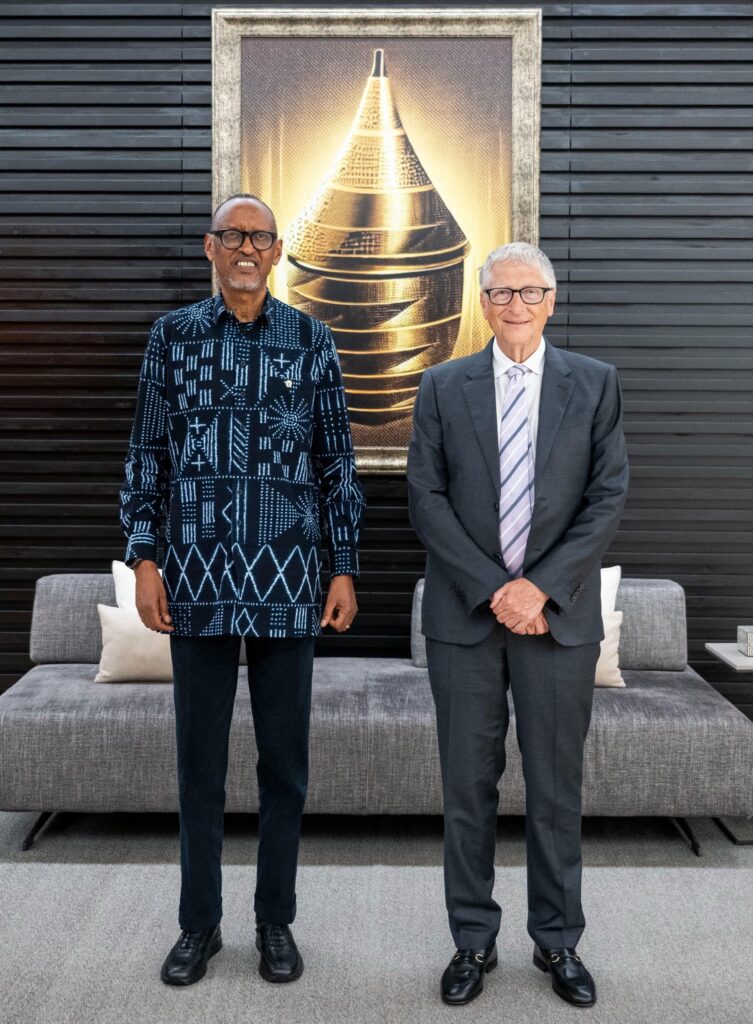
President Paul Kagame and American philanthropist Bill Gates have discussed ways to strengthen cooperation between Rwanda and the Gates Foundation, with a focus on healthcare, agriculture, artificial intelligence and digital infrastructure.
The talks were held on July 20, 2026, during Gates’ visit to Rwanda, which focused on assessing the country’s progress in healthcare and other key development areas.
According to the Office of the President, the two leaders discussed expanding collaboration to accelerate initiatives that support Rwanda’s development, including improving healthcare systems, advancing agricultural productivity, promoting artificial intelligence solutions and strengthening technology infrastructure.
“President Kagame and Bill Gates discussed strengthening the partnership between Rwanda and the Gates Foundation, including accelerating collaboration in healthcare, agricultural development, artificial intelligence and technology infrastructure to advance Rwanda’s development,” the statement said.
During his visit, Gates toured a syringe manufacturing facility in Rwamagana District and visited Mwulire Health Centre, where he also met a community health worker to better understand Rwanda’s healthcare delivery model from the grassroots level.
He also visited the Kigali Genocide Memorial, where he paid tribute to victims of the 1994 Genocide against the Tutsi and learned about the country’s history, the impact of the genocide and Rwanda’s journey of rebuilding and reconciliation over the past three decades.
In a message recorded in the memorial’s visitors’ book, Gates praised Rwanda’s resilience and progress since the genocide.
“It is truly remarkable to see how Rwanda has rebuilt after the 1994 Genocide against the Tutsi and continues to build a strong nation. This memorial is very important in ensuring that the victims are remembered and that their history is preserved,” he wrote.
Before arriving in Rwanda, Gates said he wanted to learn more about how the country had transformed its systems and implemented programmes that deliver services directly to communities.
He highlighted Rwanda’s progress in healthcare, noting that since 2000, deaths among children under five have declined by 80 percent, while maternal deaths linked to pregnancy and childbirth have dropped by 85 percent.
Through the Gates Foundation, Gates is supporting Rwanda’s efforts to integrate artificial intelligence into healthcare, including initiatives aimed at improving maternal care and disease management.
One of the initiatives, Horizon 1000, is an AI-based programme designed to assist healthcare workers and improve services at primary healthcare facilities. The project began with pilots in Rwanda and aims to expand access to AI tools in 1,000 healthcare facilities across Africa by 2028.