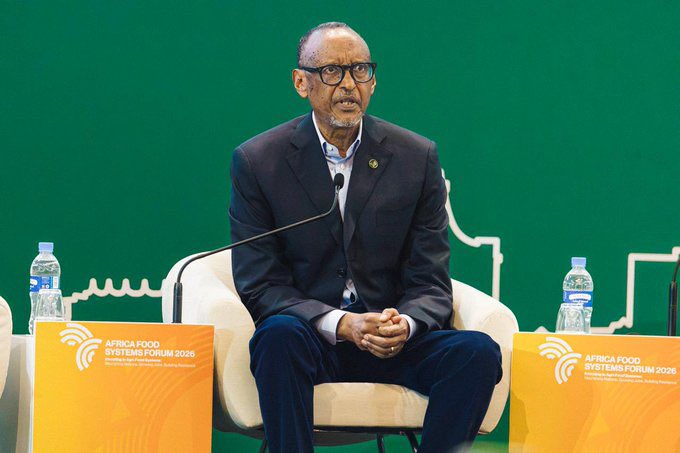
President Paul Kagame has challenged African governments to make it easier for young entrepreneurs to access capital, arguing that the continent will struggle to transform its food systems if financing continues to favour people who already have wealth and collateral.
Kagame said Africa has the resources, ideas and young talent needed to become more self-sufficient in food, but governments must create conditions that allow young people to turn their ideas into businesses.
He made the remarks during a conversation with young Africans working in agriculture and across the food value chain at the Africa Food Systems Forum in Kigali.
The President said access to food goes beyond an economic concern, describing it as fundamental to human life and development.
“Food is life. A person cannot work well or live well without food. It is one of the basic elements of human life and human wellbeing,” Kagame said.
He argued that Africa’s food challenge must be addressed across the entire value chain, from production and processing to markets and consumers.
But Kagame identified access to finance as one of the biggest obstacles facing young people seeking to invest in agriculture and food-related businesses.
He criticised financial systems that often make it easier for people who already have assets to secure loans, while entrepreneurs with promising ideas but little collateral struggle to obtain the capital needed to start.
“The unfortunate thing is that in many parts of Africa, financial institutions are structured in a way that capital mainly goes to people who already have capital,” he said.
Kagame called on governments to bridge this financing gap by creating mechanisms that connect young entrepreneurs with financial institutions and reduce the risks associated with investing in new businesses.
He pointed to Rwanda’s experience, citing the Rwanda Development Board and government-backed initiatives designed to expand access to capital for people who may not have sufficient resources to launch businesses.
He said governments should also be prepared to support promising youth-led ventures where necessary, arguing that the long-term economic returns could outweigh the initial risks.
Asked where he would invest if he were a young entrepreneur in Africa’s food economy, Kagame said opportunities exist throughout the food value chain.
He encouraged young people to identify gaps in the market where their skills, knowledge and interests can provide practical solutions.
“I would encourage young people to look at where their willingness, knowledge or opportunities meet a gap, and put their efforts there,” he said.
Once an opportunity has been identified, he advised entrepreneurs to focus on securing capital, finding partners and acquiring skills they may lack rather than waiting for perfect conditions.
Kagame also urged young people to distinguish between problems they can realistically solve and those that should be addressed later, saying self-reflection can help them identify the barriers that most directly affect their progress.
His message comes as the Africa Food Systems Forum places investment and finance at the centre of efforts to transform the continent’s agriculture, create jobs and build more resilient food systems.
For Kagame, Africa’s food future will depend not only on producing more food, but also on whether governments and financial institutions can unlock the capital needed for a new generation of entrepreneurs to build businesses across the food chain.