The City of Kigali has warned residents and businesses against discharging untreated wastewater and waste into wetlands, saying the practice threatens biodiversity and undermines ongoing efforts to restore the city’s degraded wetland ecosystems.
The warning comes as Kigali advances the rehabilitation of five major wetlands covering a combined 491 hectares. The sites are Nyabugogo, Kibumba, Rugenge-Rwintare, Rwampara and Gikondo. The rehabilitation programme is designed to improve water quality, restore biodiversity and strengthen the wetlands’ role in reducing flood risks.
Despite the restoration works, wastewater remains a challenge because polluted water continues to enter some wetlands through drainage channels and waterways.
Engineer Mwumvaneza Vincent, who is involved in the rehabilitation of the wetlands, said restoration teams found industrial waste and other pollutants in some of the sites.
“We found industrial waste still present in the wetlands. The first thing we did was remove it so that the organisms in the wetlands could survive properly,” he said.
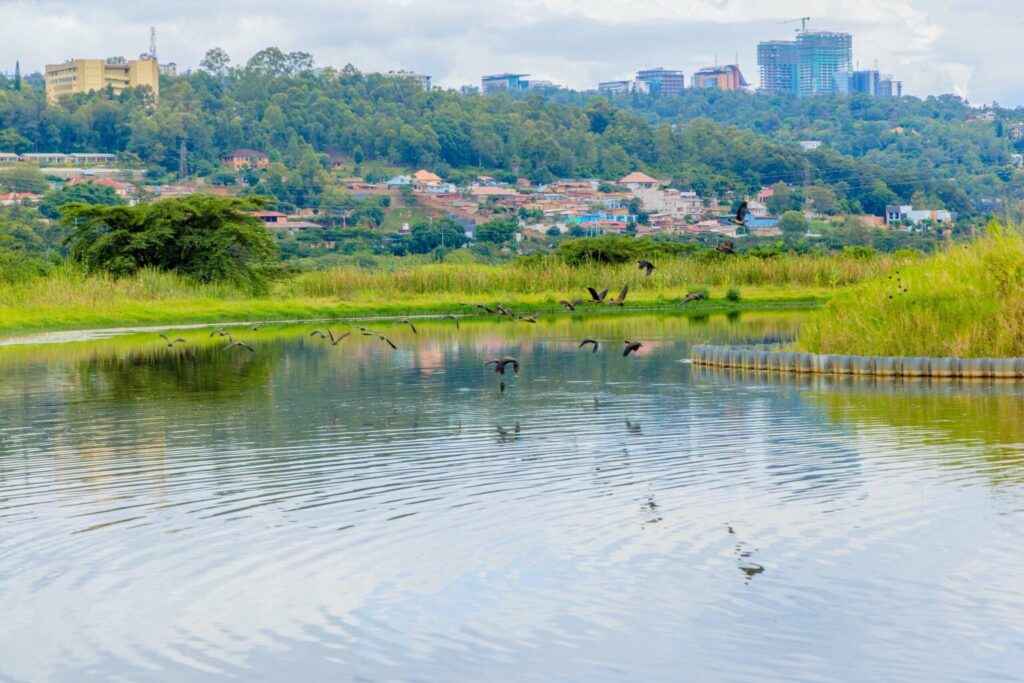
He said the rehabilitation has also involved planting trees, creating ponds and restoring habitats to encourage the return of birds and other wildlife.
“We planted trees, created ponds and introduced different types of trees where birds could perch and which could attract different bird species to the wetlands,” Mwumvaneza said.
However, he noted that continued pollution could undermine these efforts.
Peace Uzmukuza, deputy manager of Nyandungu Eco-Park, said wastewater containing chemicals can damage aquatic life and reduce a wetland’s ability to naturally filter water.
“The problem with waste is that some of the water enters drainage channels and eventually flows into the ponds. When it contains chemicals, the organisms die,” she said.
She added that in cases where pollution is severe, contaminated water may have to be diverted while authorities investigate its source.
Kigali warns against illegal discharge
The City of Kigali is urging residents and businesses to stop releasing untreated wastewater into drainage channels and waterways that eventually flow into wetlands.
City of Kigali spokesperson Emma Claudine Ntirenganya said such discharges are prohibited and can attract penalties.
“Wastewater must not be discharged into drainage channels or waterways. It is strictly prohibited and punishable, with the penalty depending on the volume of wastewater released by a building,” Ntirenganya said.
She said authorities have also encountered cases where wastewater, including sewage, is discharged into waterways before flowing into wetlands undergoing rehabilitation.
“We have seen cases where people discharge wastewater into waterways, sometimes including sewage, which then flows into wetlands that are being rehabilitated,” she said.
The city says preventing pollution is essential to ensuring that restored wetlands can continue providing environmental services, including water filtration, biodiversity conservation and flood management.
Rehabilitation reaches 94%
The rehabilitation of Kigali’s five major wetlands has reached 94%, according to recent updates on the project.
The five wetlands cover 491 hectares. Gikondo accounts for 162 hectares, Nyabugogo 131 hectares, Kibumba 68 hectares, while Rugenge-Rwintare and Rwampara each cover 65 hectares.
The restoration is part of Kigali’s wider effort to use wetlands as natural infrastructure for a rapidly growing city. The programme is expected to improve water quality, protect biodiversity and strengthen the wetlands’ capacity to manage stormwater and reduce flooding.
The restored wetlands are also expected to support tourism, recreation, environmental education and other economic activities.
Environmental authorities say the success of the restoration will depend not only on rehabilitation works but also on preventing further pollution and protecting the wetlands from activities that could undermine their ecological functions.