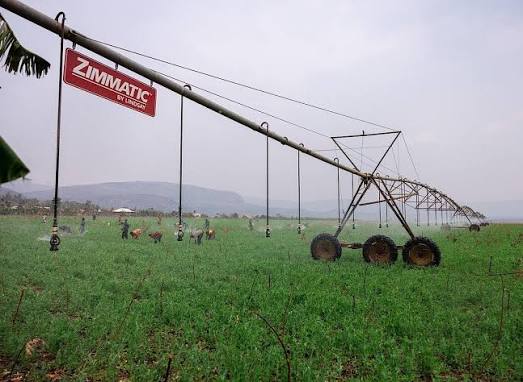
Farmers in the Nasho, Mpanga, Mahama and Nyamugali irrigation schemes in Kirehe District are expected to start using modern irrigation systems during the 2027B agricultural season, as the installation of centre-pivot irrigation equipment nears completion.
The power infrastructure needed to operate the systems is also under construction, with work on the electricity facility more than 75% complete.
Farmers say prolonged dry spells in the area often cause crops to wither before harvest, leaving them with losses despite the money invested in cultivation. They hope the new irrigation systems will help them increase production and improve their incomes.
In the Nyamugali irrigation scheme, some farmers have already planted their crops, while others are still preparing their fields. However, persistent dry conditions remain a challenge, with crops drying out before reaching maturity or during the fruiting stage.
One farmer told Rwanda Broadcasting Agency (RBA) that maize sometimes dries up before harvest, forcing farmers to cut it for livestock feed after spending money to grow it.
He said farmers sometimes plant maize in holes during dry periods, only for the seedlings to wither or the crops to dry out after developing ears, resulting in losses.
The challenge has increased farmers’ demand for a reliable irrigation system that would allow them to grow crops without depending entirely on uncertain rainfall.
Centre-pivot irrigation machines have been installed across the Nasho, Mpanga, Mahama and Nyamugali schemes to irrigate large areas of farmland. Although the equipment is not yet operational, farmers expect it to bring significant improvements to their farming activities.
One farmer said progress on the installation work had raised hopes of better harvests in the coming seasons.
Nzirabatinya Modeste, Kirehe District’s deputy mayor in charge of economic development, said the installation work had reached the stage where water would be supplied to test how the equipment operates.
“The work has been completed, and the next step is to introduce water and see how the systems perform,” he said.
An electricity facility is being built in Nyamugali Sector to provide the power required to operate the irrigation equipment. Construction is more than 75% complete.
The transmission infrastructure is expected to be completed in November 2026, followed by testing in December. Electricity could then become available for use in January 2027.
Nzirabatinya said the developments were expected to enable farmers in the four schemes to access water through modern irrigation systems, particularly during the 2027B agricultural season.
He said the transmission infrastructure was scheduled for completion in November, with testing planned for December and operations expected to begin in January.
Farmers will continue using their existing farming methods during the 2027A season, but authorities expect electricity to be available by the 2027B season to power the irrigation machines.
The deputy mayor said the district was optimistic that the two centre-pivot systems nearing completion would have sufficient electricity to irrigate the entire targeted area.
The modern irrigation systems are expected to help farmers reduce losses caused by drought, increase crop yields and make better use of their farmland.
However, their operation will depend on completing the remaining works, testing water delivery to the fields and ensuring a reliable electricity supply.