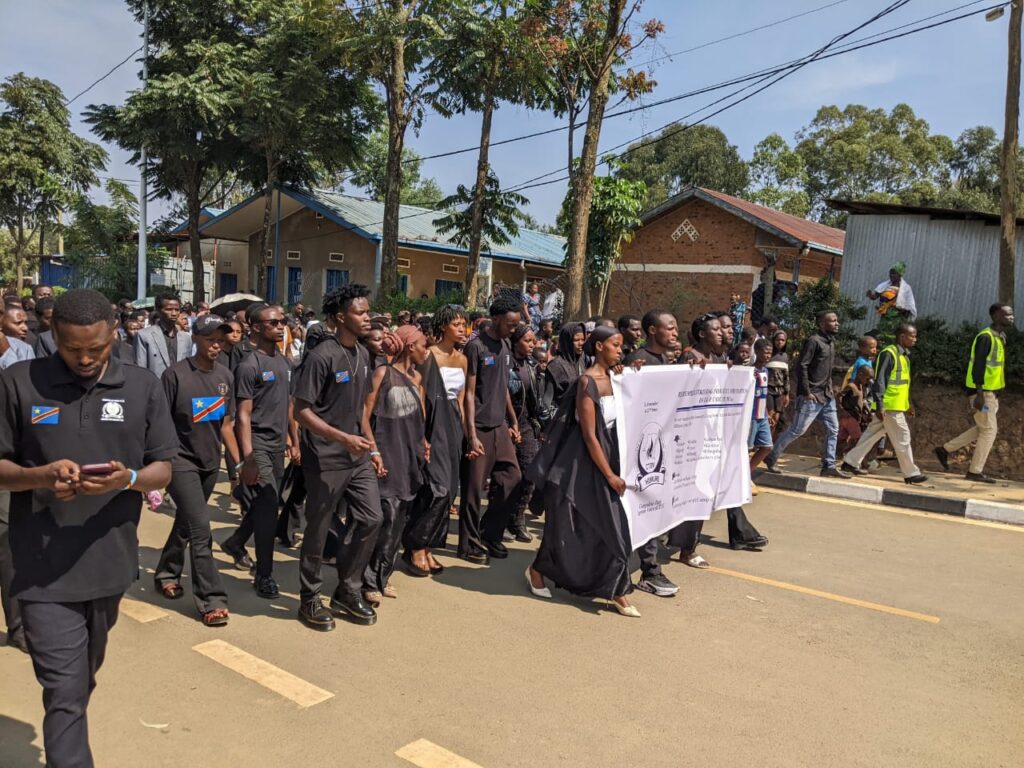
Congolese refugees living in Rwanda’s Kiziba Refugee Camp have called for justice and a safe return to their homeland as they commemorated people they say were killed in attacks targeting Kinyarwanda-speaking communities in the Democratic Republic of Congo.
The commemoration was held on Monday in Karongi District, bringing together mainly young refugees to honour victims and reflect on what they described as continued violence, discrimination and insecurity affecting Congolese Tutsi and other Kinyarwanda-speaking communities in eastern DRC.
Participants carried placards bearing messages including, “We remember, rebuild ourselves, seek justice and return home.”
Some participants called for the killings of Congolese Tutsi to be formally recognised as genocide, arguing that accurately naming and documenting the crimes would help preserve historical memory and support efforts to hold perpetrators accountable.
They said victims killed in different parts of the DRC and Burundi should not be forgotten and that their experiences should be passed on to younger generations.
Participants also stressed the importance of teaching children born or raised in exile about their families’ history in a way that promotes peace, justice and reconciliation rather than hatred.
The commemoration comes as insecurity and conflict continue to affect parts of eastern DRC, where Kinyarwanda-speaking communities have faced displacement and attacks amid decades of armed conflict.
Kiziba is one of Rwanda’s longest-established refugee camps. It was established in 1996 to host Congolese refugees fleeing violence in eastern DRC and has continued to shelter generations of refugees, including young people born in the camp.
The refugees’ history is closely linked to prolonged conflict in North Kivu and South Kivu, where successive waves of violence have forced communities to flee their homes and seek safety in neighbouring countries, including Rwanda.
For the young refugees who took part in the commemoration, the message was both about remembering the past and demanding a future in which they can return home in safety and dignity.