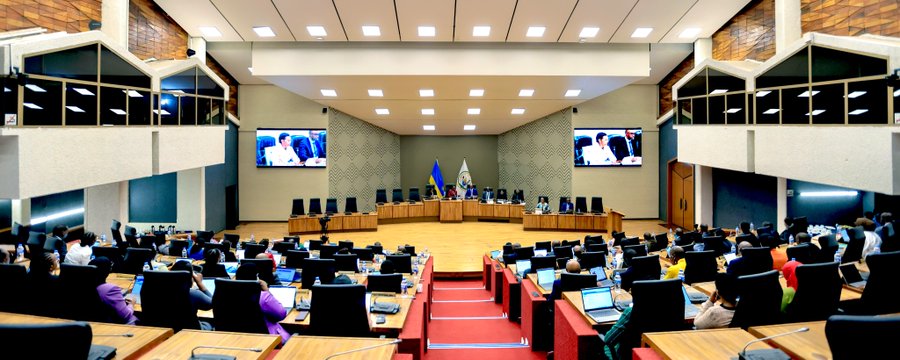
Rwanda’s Parliamentary Public Accounts Committee (PAC) has called for investigations and possible prosecution of public institutions accused of mismanaging government funds, urging the Ministry of Justice to work with prosecution authorities to ensure accountability.
The recommendation was made among resolutions adopted by PAC on Tuesday, August 4, 2026, after reviewing the Auditor General’s report on government budget management for the 2025/2026 financial year.
PAC said several institutions spent public funds without providing adequate documentation or clear explanations on how the money was utilised, raising concerns over accountability and value for money.
Among the cases flagged was the Rwanda Housing Authority (RHA), where lawmakers questioned the expenditure of more than Rwf45.7 million on artificial grass installed at Huye Stadium, saying the institution had not provided sufficient justification for the cost.
The committee also raised concerns over more than Rwf340 million added to the budget for construction of wastewater treatment facilities at Muhima and Bushenge hospitals, despite the contracts not being formally amended.
PAC further questioned RUGC Ltd, a subsidiary of the Rwanda Social Security Board (RSSB), over the purchase of kitchen equipment worth Rwf1.5 billion for a hotel that has not yet been built.
The lawmakers said the equipment has remained unused since 2023, while RUGC Ltd continues to spend about Rwf1.8 million monthly on storage costs. The company was also unable to provide supporting documents explaining the use of Rwf3.34 billion, according to PAC.
PAC Chairperson Valens Muhakwa said delays in completing government projects remain a major challenge affecting development efforts, with some projects stalled due to procurement delays, contract extensions and slow implementation.
Projects cited included cross-border roads, G+ school construction projects, the Rwanda Digital Acceleration Project and programmes implemented by the National Agricultural Export Development Board (NAEB).
The committee also raised concerns over expensive equipment purchased by public institutions but left unused.
PAC highlighted challenges at the Water and Sanitation Corporation (WASAC), including delays in connecting new customers, treated water that is not being fully utilised and slow progress on major projects such as the Kigali Centralised Sewage System.
The committee recommended that Parliament summon the Minister of Infrastructure to explain measures being taken to address procurement challenges, infrastructure maintenance and wastewater management.
In the education sector, PAC raised concerns over the Smart Education programme, citing damaged equipment that remains unrepaired and persistent internet connectivity challenges in many schools. The Ministry of Education was given six months to address the issues.
Rwanda Polytechnic was also ordered to refund Rwf256.6 million in student caution fees collected over different periods within six months.
In the health sector, PAC gave the Ministry of Health 12 months to resolve challenges affecting wastewater treatment facilities and medical waste incinerators in health facilities across the country.
The ministry was also instructed to recover Rwf26.3 million that was overpaid to a contractor by Rwanda Biomedical Centre (RBC) under a project to construct 24 medical waste incinerators.
PAC further urged the Ministry of Infrastructure to speed up delayed projects, including the Base–Kidaho road, the Nkombo boat project, G+ schools in Musanze, the Bumbogo affordable housing project and the Kigali wastewater treatment plant.
The Ministry of Local Government was asked to resolve challenges affecting community road construction programmes implemented with the City of Kigali and address the relocation of residents in Nyabihu District who were settled in areas restricted due to their proximity to Volcanoes National Park.
PAC also called on the Prime Minister to strengthen coordination among institutions implementing programmes aimed at fighting malnutrition and child stunting through the Fortified Blended Food (FBF) initiative.
The committee said gaps in coordination and joint planning among institutions, including the Ministry of Health, Rwanda Biomedical Centre, Rwanda Medical Supply, MIGEPROF through NCDA, and MINALOC, had affected implementation.
Lawmakers further recommended investigations into funds provided by the Rwanda Technical and Vocational Education and Training Board (RTB) to the City of Kigali and Bugesera District.
In agriculture, PAC highlighted delays in projects such as the Nyamagabe livestock breeding centre, which was expected to be completed in February 2024 but had not started construction by 2025.
PAC conducted public hearings involving 76 government institutions selected from the Auditor General’s report based on serious concerns over misuse of public resources and failure to implement previous recommendations.