Rwanda’s President Paul Kagame has described U.S. involvement in resolving the longstanding conflict between Rwanda and the Democratic Republic of Congo (DRC) as “unprecedented,” praising the Trump administration’s hands-on approach as the most serious international effort he has seen in decades.
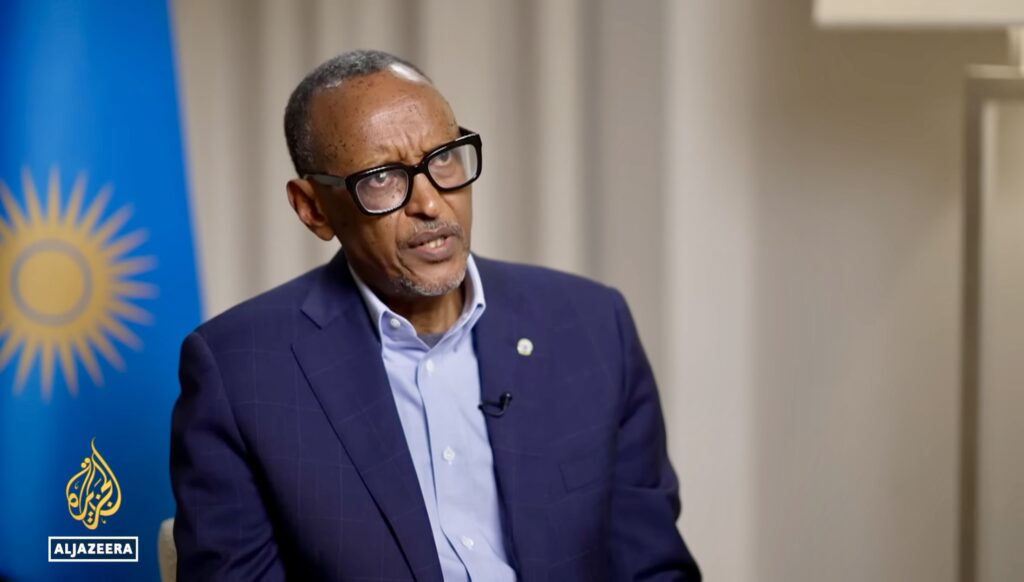
In an exclusive interview with Al Jazeera’s The Bottom Line, Following the signing of a framework agreement in Washington, brokered by U.S. President Donald Trump, Kagame described the deal as a historic moment in the bid to end decades of cross-border tensions, rooted in the aftermath of the 1994 Rwandan genocide.
“This conflict goes back many years,” Kagame said. “But we have never had anything like this, where the two leaders come to meet with the president of the United States, who has paid attention to this problem. The visibility, the energy, the pressure—this has never been like this before.”
Political, security, and economic foundations
Kagame explained that the agreement addresses the crisis through three core pillars: political engagement, security arrangements, and economic cooperation.
“In theory, it captures everything,” he said. “The real challenge will be implementation, because that’s where complications always arise.”
For years, international efforts to address the conflict have largely focused on narratives around democracy, human rights, and freedom, which Kagame said often failed to translate into tangible improvements for affected populations. He emphasized that practical results, not rhetoric, are critical.
“What matters are results,” Kagame said. “I prefer approaches that focus on real, measurable outcomes.”
Qatar’s role and the two-track process
The Rwandan president also highlighted Qatar’s mediation in parallel talks, which focused on internal Congolese political dialogue, while Washington managed bilateral issues between Kigali and Kinshasa.
Kagame clarified that this dual-track approach was initiated by DRC President Félix Tshisekedi and not by Rwanda, despite accusations from other African leaders that Kigali had abandoned regional initiatives.
“Tshisekedi thought he could manipulate either the process in Qatar or the process in Washington in his favor,” Kagame said. “But the two tracks ended up being separated to ensure nothing important was missed.”
He credited Qatar for its consistent commitment to mediation, describing it as an important player in stabilizing the region.
Trusting Tshisekedi with caution
Asked about Tshisekedi’s ability to uphold agreements, Kagame expressed cautious optimism.
“It is important that we are here, agreeing to sign an agreement. That is the first step,” he said. However, he warned that the DRC has a history of backtracking on commitments: “It has happened not once, not twice, but many times.”
He expressed hope that both the U.S. and Qatar would remain actively engaged to ensure accountability for both parties.
Defending Rwanda’s minerals and regional stability
Kagame also addressed longstanding accusations regarding Rwanda’s mineral exports. He rejected claims that Rwanda’s tungsten, tin, tantalum, lithium, and gold originate from the DRC, calling such narratives part of a “blame game” often shaped by geopolitical interests.
“Tungsten, tin, tantalum, these exist in Rwanda, of very high quality,” he said, noting long-term U.S. investment in the sector. “What we have has nothing to do with DRC.”
He accused some Western governments of downplaying Rwanda’s security concerns and covering up support for FDLR militias while unfairly targeting Kigali.
Trump as an unlikely peacemaker
While Kagame dismissed the idea of himself or Trump being considered for a Nobel Peace Prize, he praised the U.S. president for taking tangible steps to resolve the conflict.
“Given what he has done in a short time and trying to stabilize things… he shows good intention,” Kagame said. “But nobody can deliver results alone. We must also do our part.”
Kagame said he values leaders focused on results rather than rhetoric. “There are many people who say nice things and end up with nothing. But here, we have a real chance to make progress.”
Optimism amid uncertainty
Despite his praise for the Trump administration and Qatar’s mediation, Kagame acknowledged the risks. Dozens of armed groups remain active in eastern DRC, and previous agreements have often unraveled due to competing interests.
Still, Kagame said the current framework represents the “most focused effort” he has witnessed to address the region’s chronic instability.
For now, attention turns to the signing of the agreement in Washington, where Kigali, Kinshasa, and their international partners hope that sustained engagement will finally break the cycle of conflict that has plagued the Great Lakes region for decades.