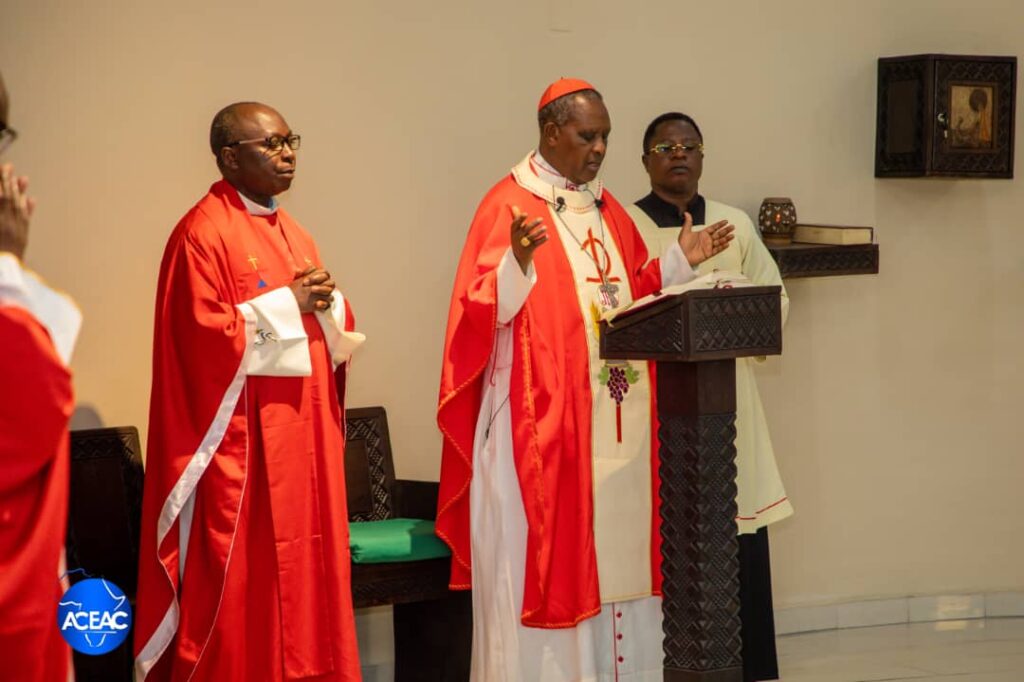
The president of the Rwanda Episcopal Conference and archbishop of Kigali, Antoine Cardinal Kambanda, has expressed deep concern that the Great Lakes region, despite having a large Christian population, continues to be plagued by wars, conflicts, and rising insecurity.
He made the remarks on November 13, 2025, while addressing the general assembly of the association of Catholic bishops from Rwanda, Burundi, and the Democratic Republic of Congo, held in Kinshasa.
Cardinal Kambanda observed that although the number of Christians in Africa continues to grow, this increase is often not reflected in lifestyles and conduct that align with Christian values.
In his address, he voiced serious concern that some countries which were once strongholds of Christianity and centers of evangelization are now experiencing a decline in the number of believers.
He noted that while the Church in Africa continues to grow in numbers and in vocations to religious life, it still faces major challenges related to moral conduct and ways of life that are inconsistent with Gospel teachings.
Cardinal Kambanda emphasized that even in countries where the Church is expanding numerically, the major challenge that remains is living authentically according to the Gospel of love and fraternity.
He warned that the gap between the number of believers and their daily conduct risks creating deep contradictions, which can ultimately undermine the credibility and witness of the Church in society.
To illustrate his point, he cited the Great Lakes region, highlighting the disconnect between the high number of Catholic faithful and the persistent rise in conflicts, wars, and violence that continue to characterize the area.
He explained that many of these conflicts are fueled by the failure of faith to transform hearts and systems of governance, resulting in a wide gap between Christian values and the conduct evident in political leadership and public life.
Cardinal Kambanda also addressed the issue of leadership in Africa, expressing concern that many leaders were educated in Catholic institutions, yet once in positions of power, they fail to demonstrate the values and ethical standards consistent with the formation they received.