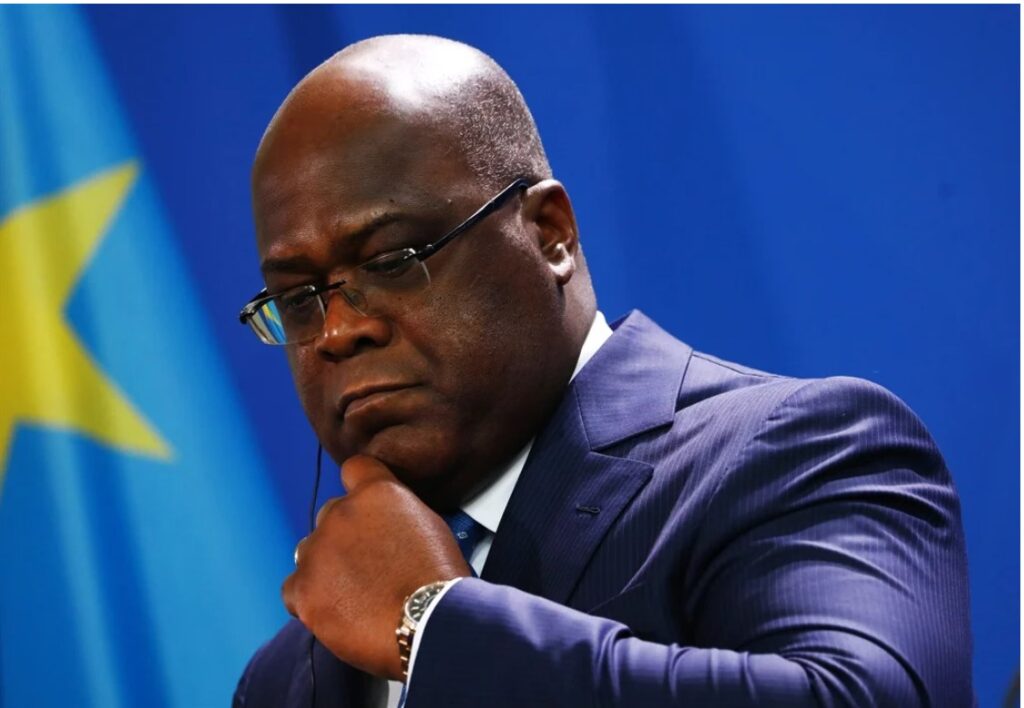
The year 2025 marked another dramatic chapter in the long-running conflict in the eastern Democratic Republic of the Congo (DRC), leaving President Félix Antoine Tshisekedi politically and militarily constrained as the M23 rebel movement seized major urban centers, including Goma and Bukavu.
Despite being Africa’s second-largest country by landmass, the DRC has for nearly three decades struggled to assert full control over its territory. Persistent insecurity, driven by a proliferation of armed groups such as the FDLR, has repeatedly undermined state authority, particularly in the eastern provinces.
Roots of the conflict
The origins of M23 trace back to the March 23, 2009 peace agreement between the Congolese government and the CNDP (National Congress for the Defence of the People).
Under that deal, CNDP was transformed into a political movement, and its fighters were integrated into the national army.
However, tensions resurfaced in 2012 when former CNDP combatants accused the government of failing to honor the agreement and subjecting them to poor conditions within the military. M23 re-emerged, launching attacks on government positions in Masisi Territory and later capturing Goma.
Although the International Conference on the Great Lakes Region (ICGLR) intervened and urged M23 to withdraw from Goma after the Congolese government agreed to talks, fighting continued intermittently.
With support from the UN peacekeeping mission, FARDC later retook the city, prompting M23 to declare a halt to hostilities.
Following its defeat, some M23 fighters, led by Sultan Makenga, fled to Uganda, while others under Jean-Marie Runiga Lugerero crossed into Rwanda.
At the time, Rwanda came under intense diplomatic pressure amid allegations of backing M23, claims Kigali consistently denied. These accusations severely strained relations between Rwanda and the DRC.
A brief thaw, then renewed tensions
When Tshisekedi assumed office in 2019, relations between Kigali and Kinshasa initially improved.
However, the calm proved short-lived. As M23 resumed operations, relations deteriorated sharply. The Congolese government cancelled bilateral agreements with Rwanda and expelled Rwanda’s ambassador.
President Tshisekedi argued that because many M23 fighters speak Kinyarwanda, they were often perceived as Rwandan, a claim Rwanda rejected, instead pointing to the continued presence of FDLR elements inside the DRC as a direct threat to its security.
The fall of Goma
At the beginning of 2025, M23 announced it had captured Goma, the capital of North Kivu Province and a strategic hub in eastern Congo. On January 27, 2025, the group’s political spokesperson, Lawrence Kanyuka, confirmed the takeover.
“We call on the residents of Goma to remain calm. The liberation of the city was successfully completed, and the situation is now under control,” he said.
Before entering nearby Sake on January 23, M23 had spent nearly a year entrenched in the surrounding hills. Intense fighting in the area claimed the life of Major General Peter Cirimwami, the governor of North Kivu Province.
The loss of Goma, along with its strategic airport, was a major blow to President Tshisekedi. It signaled a significant erosion of state control and left his government under mounting domestic and international pressure.
A shift in strategy
Facing growing setbacks, Tshisekedi shifted his narrative, arguing that FARDC was not fighting M23 alone but confronting Rwanda directly. He embarked on an international campaign, urging global powers to impose sanctions on Kigali.
While Kinshasa focused on diplomatic offensives, M23 continued to expand its territorial control, claiming it was prioritizing civilian protection in areas under its administration.
Advance to Bukavu
On February 16, 2025, M23 announced it had taken Bukavu, the capital of South Kivu Province, after pushing out Congolese forces and allied militias.
In the days that followed, the group launched operations to disarm individuals still hiding weapons in the city and pursued fleeing soldiers toward Bukavu’s southern outskirts.
By February 18, 2025, M23 had seized control of the DRC side of the Kamanyola border crossing linking the country to Rwanda, after expelling fighters from the Wazalendo militia coalition.
The capture of Bukavu followed M23’s earlier takeover of Kavumu and its strategic airport, further consolidating the group’s grip on South Kivu.
Defiance and mediation
Despite the losses, President Tshisekedi remained defiant, continuing to accuse Rwanda of invading Congolese territory. Rwanda repeatedly denied the accusations, instead highlighting the Congolese government’s failure to neutralize FDLR fighters operating from within the DRC.
Eventually, Tshisekedi turned to international mediators, including the United States and Qatar, to facilitate dialogue with Rwanda. Although agreements were reached, tensions persisted, with Kinshasa continuing to level accusations against Kigali.
Shifting realities on the ground
Residents in parts of Goma and Bukavu report relatively improved security compared to the period when the areas were under FARDC control, though uncertainty remains high.
In early December 2025, M23 announced it had captured the city of Uvira. However, citing ceasefire commitments and respect for Qatar’s role as mediator in peace talks, the group declared a halt to fighting and later withdrew from the city.
M23 has repeatedly called for direct negotiations with the Congolese government. For a long time, Tshisekedi resisted dialogue. But after losing key territories, including Goma, his government agreed to return to the negotiating table, acknowledging that compromise may be necessary to restore stability in eastern Congo.
As of now, M23 says it is implementing ceasefire commitments, even as it accuses the Congolese government of continuing aerial attacks that have affected civilians.
For President Tshisekedi, 2025 proved to be a year of narrowing choices, one in which military setbacks, diplomatic pressure, and shifting realities on the ground forced a reluctant reassessment of strategy in the quest for peace in eastern Congo.