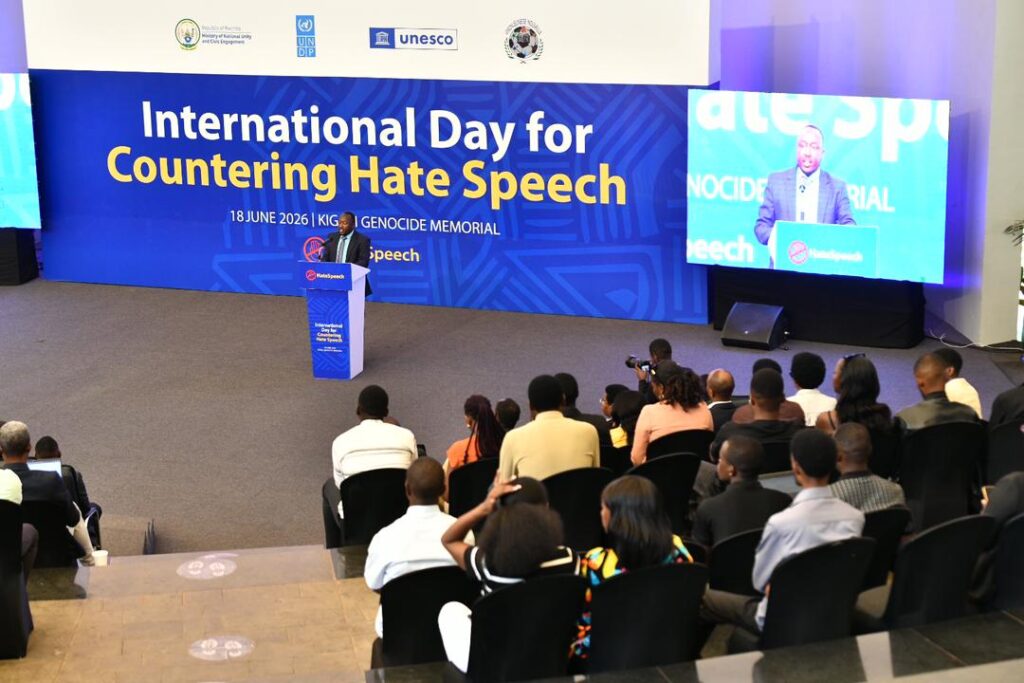
Rwanda’s Minister of State for National Unity and Civic Engagement, Uwitonze Mahoro Eric, has announced renewed government efforts to intensify the fight against hate speech, including strengthening public awareness, prevention mechanisms, and accountability measures.
He made the remarks on Thursday, June 18, during the commemoration of the International Day for Countering Hate Speech held at the Kigali Genocide Memorial.
The event also featured the presentation of a draft National Action Plan designed to guide national efforts against hate speech and related harmful narratives.
It brought together government officials, development partners, youth representatives and other stakeholders, who discussed strategies to prevent hate speech through education, peacebuilding, and coordinated action across institutions.
Uwitonze said the day carries deep meaning for Rwanda, as it reflects both the country’s painful history shaped by divisive rhetoric and the progress made in rebuilding national unity.
He noted that Rwanda has made significant progress in strengthening social cohesion, with the national unity index currently estimated at 95.3%.
He said the new action plan will reinforce ongoing efforts to counter all forms of speech that promote division, including not only genocide ideology but also subtle narratives that fuel hatred and mistrust.
Public education, he added, will remain central to the strategy, particularly in helping citizens identify and reject harmful narratives before they spread.
Uwitonze also stressed the importance of stronger inter-institutional cooperation to detect, report and respond to hate speech, emphasizing that accountability will be a key component of the approach.
He said those who engage in hate speech should face consequences, as part of efforts to prevent impunity and protect social cohesion.
The Executive Director of Vision Jeunesse Nouvelle highlighted the critical role of young people in countering hate speech, noting that “words have power—they can unite or divide, build or destroy, heal or harm.”
She emphasized that youth engagement is essential in promoting peace, unity and stronger social cohesion across communities.
The National Action Plan on hate speech is structured around five pillars and includes both short- and long-term interventions aimed at strengthening existing frameworks, promoting youth participation as peace ambassadors in digital spaces, and tackling misinformation and disinformation in an increasingly digital environment.