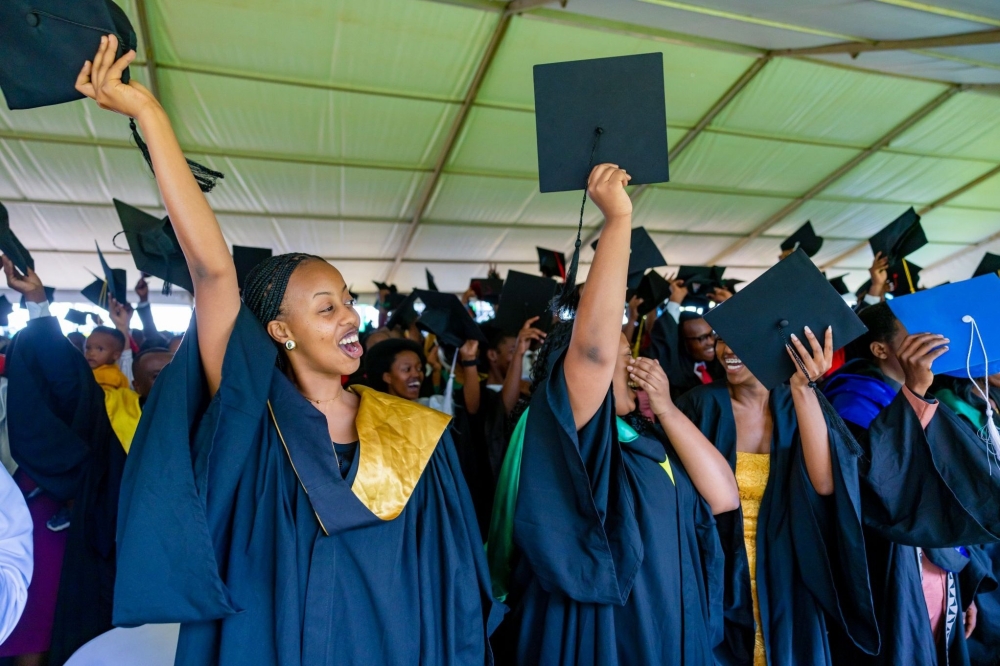
For thousands of Rwandan students, graduation marks the beginning of a new chapter filled with hope that a university degree will open doors to employment. But as more graduates enter an increasingly competitive labour market, academic qualifications alone may no longer guarantee a job.
After graduation, many young people spend months applying for vacancies, sitting recruitment tests and waiting for responses. For some, the search can stretch much longer.
The challenge is becoming more significant as Rwanda expands access to higher education and produces more graduates each year.
More than 130,000 students were enrolled in higher education in the 2023/24 academic year, according to figures cited in the original report. Students were pursuing programmes ranging from education and arts to business, technology, construction, health and agriculture.
The expansion is helping Rwanda build a more highly educated workforce, but it also raises a critical question: Are graduates acquiring the skills employers need?
Unemployment remains a challenge
The latest Labour Force Survey from the National Institute of Statistics of Rwanda (NISR) shows that unemployment stood at 13.4% in May 2026, while youth unemployment was higher at 15.7%. The labour underutilisation rate stood at 59.7%, indicating that unemployment alone does not capture the full extent of unmet demand for work.
The figures highlight the pressure facing Rwanda’s labour market, particularly among young people entering employment for the first time.
Although unemployment is only one measure of labour-market conditions, the data shows that securing a job remains a significant challenge for a large number of job seekers.
Employers looking beyond academic qualifications
A university degree remains an important qualification for many professional positions. However, employers increasingly want candidates who can demonstrate what they can actually do with the knowledge they acquired in school.
Practical skills, work experience, digital competence, communication, problem-solving and adaptability can make a significant difference when employers assess candidates.
Some employers argue that graduates sometimes arrive at workplaces with strong theoretical knowledge but struggle to apply it to real-world tasks, requiring additional training before they can work independently.
This can influence employers to favour candidates who demonstrate practical competence and relevant experience, even when their academic qualifications are not an exact match for the position.
The education-employment gap
The debate therefore goes beyond the number of students graduating from universities.
It raises questions about whether academic programmes are sufficiently aligned with the changing needs of Rwanda’s economy and whether students have enough opportunities to gain practical experience before graduation.
As more young people obtain university qualifications, competition for professional jobs can also intensify.
The challenge for higher education institutions is consequently not only to produce more graduates, but to ensure that those graduates leave with skills that can translate into employment, entrepreneurship and productivity.
What does the future hold?
A degree still matters. It can provide the academic foundation required for many careers and remains an essential qualification for numerous positions.
But the labour market is increasingly rewarding a broader combination of qualifications and abilities.
For today’s university student, the question is therefore no longer simply whether they will graduate.
It is whether, by the time they graduate, they will have the practical skills, experience and adaptability needed to turn their education into meaningful economic opportunities.
In Rwanda’s evolving labour market, the degree may open the door, but what a graduate can do with it may determine how far they go.