Rwanda has urged the United Nations to shift its focus from crisis management to proactive prevention, pointing to the ongoing conflict in the eastern Democratic Republic of Congo as proof of the global body’s shortcomings.
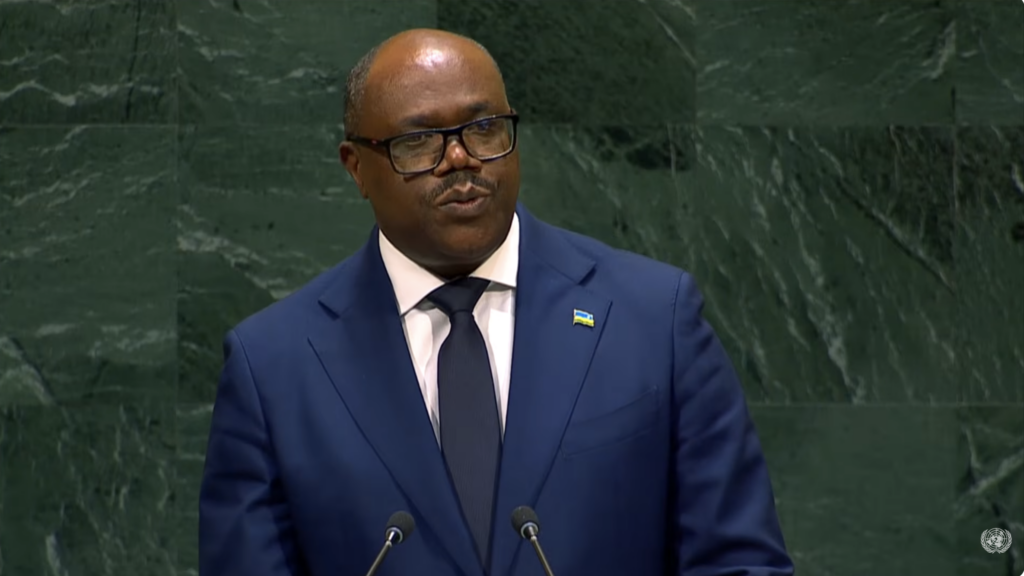
Addressing the 81st United Nations General Assembly, Rwanda’s Prime Minister Dr Justin Nsengiyumva said the UN must adapt to a rapidly changing world and demonstrate its relevance through results.
“The United Nations has yet to demonstrate that it can adapt to a changing and uncertain world,” Nsengiyumva told world leaders.
He drew parallels with Rwanda’s own experience three decades ago, saying the country survived and rebuilt by relying on its capacity to overcome enormous challenges.
“What made that possible was a simple principle and conviction that institutions earn legitimacy not by what they promise, but by what they deliver, year after year,” he said.
Eastern DRC a test for the UN
PM Nsengiyumva pointed to the conflict in eastern DRC as an example of a crisis where longstanding problems have been allowed to persist.
He highlighted the continued presence of the Democratic Forces for the Liberation of Rwanda (FDLR), an armed group operating in eastern DRC that Rwanda has repeatedly accused of spreading genocidal ideology and posing a security threat.
But the Prime Minister argued that military responses alone cannot resolve the decades-long instability in eastern DRC.
“The roots of the conflict in Eastern DRC are political, and they lie in longstanding grievances, exclusion, and failures of governance. The solution, too, therefore, must be political,” Nsengiyumva said.
He urged international actors, including the UN Security Council, to support ongoing political and diplomatic efforts aimed at finding a lasting solution to the conflict.
The eastern DRC conflict has remained one of the region’s most pressing security challenges, involving multiple armed groups and regional actors. Diplomatic initiatives have sought to address the conflict and tensions between Rwanda and the DRC.
‘Anticipate, not just respond’
PM Nsengiyumva said the problem extends beyond armed conflicts.
From pandemics and climate shocks to technological disruption, he argued that the international system has repeatedly found itself reacting to challenges rather than anticipating them.
“Too often, the United Nations has been more effective at responding to crises than anticipating them,” he said.
For Rwanda, prevention should also mean tackling poverty, economic vulnerability and unequal access to opportunities before they develop into larger crises.
“The value of prevention extends beyond conflict. It also means addressing the conditions that leave countries vulnerable to poverty, economic shocks, and exclusion from opportunity,” PM Nsengiyumva said.
Rwanda calls for UN reform
Turning to UN reform, the Prime Minister called for an international system that gives countries a fairer opportunity to pursue their own development.
Rwanda has been among African countries calling for reforms to global institutions, including greater African representation in international decision-making structures.
PM Nsengiyumva said the debate is no longer whether countries need multilateral institutions, but whether those institutions can change with the world around them.
“The question before this Assembly is not whether multilateralism remains relevant,” he said.
“It is whether our institutions are prepared to adapt to the challenges of our century, and to deliver results that matter.”