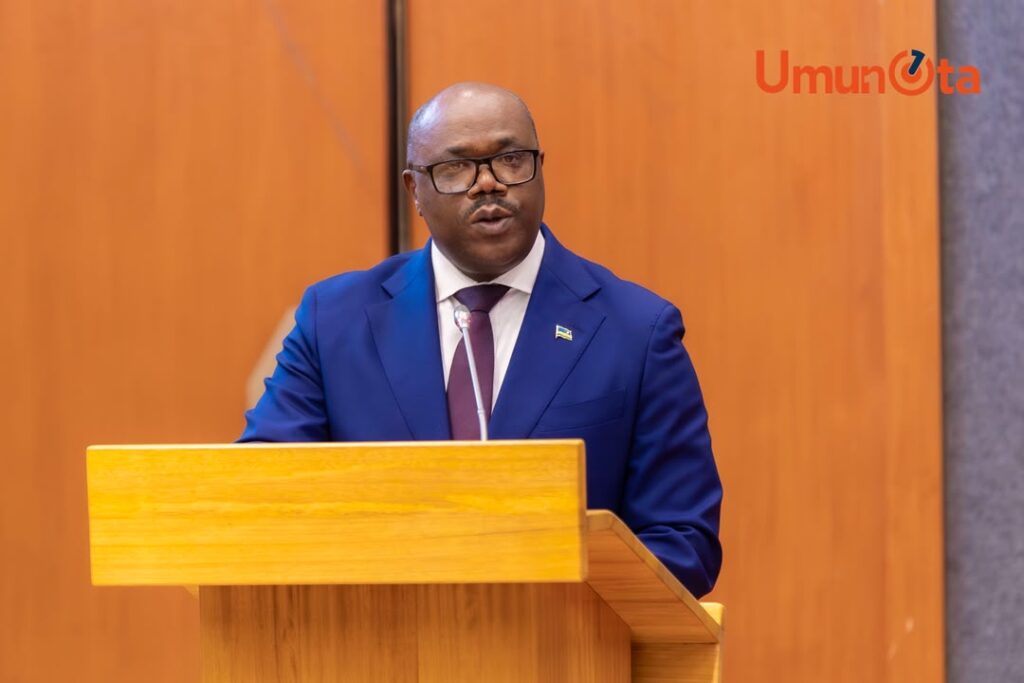
Prime Minister Dr. Justin Nsengiyumva has said Rwanda’s response to rising prices must focus on increasing domestic production rather than relying on short-term measures or emotional reactions.
He made the remarks on Friday, October 2, 2026, while presenting the government’s progress in developing the financial sector to both chambers of Parliament.
Nsengiyumva said inflation is being driven by both international market pressures and challenges within the domestic economy.
On fuel prices, he said the government has worked to diversify its sources of petroleum imports, including by sourcing products from countries such as Oman. These efforts, he said, have helped keep pump prices relatively stable at about RWF 2,900 per litre over the past two to three months.
“When dealing with the economy, we have to rely on facts rather than emotions. We cannot simply say prices will fall because we want them to. If market forces were left entirely on their own, the price could reach RWF 3,200 or even RWF 3,300,” he said.
The Prime Minister said the government’s approach to fuel imports was intended to increase competition among suppliers and limit pressure on consumers.
He argued that without such measures, fuel prices could have climbed to around RWF 4,000 per litre, potentially forcing the government to redirect funds from other priorities to subsidise diesel.
However, Nsengiyumva said there are limits to what the government can do about international factors affecting prices.
For domestic pressures, he identified low production as a major challenge. He said Rwanda needs to increase output in both agriculture and manufacturing so that supply can keep pace with growing demand.
“If incomes increase but production does not, prices will inevitably go up. We have a production problem. Some factories are operating at only 30 or 40% of their capacity, while in agriculture we have areas producing two tonnes where we could be producing 10,” he said.
Nsengiyumva said expanding the supply of locally produced goods is the most sustainable way to ease price pressures, rather than relying mainly on interventions after prices have already risen.
The National Institute of Statistics of Rwanda (NISR) reported that consumer prices in urban areas increased by 15.7% in August 2026 compared with the same month a year earlier.
Food and non-alcoholic beverages rose by 16.3%, while housing, water, electricity, gas and other fuels increased by 20.4%. Transport costs rose by 24.2%, while prices in restaurants and accommodation services increased by 15.6%.