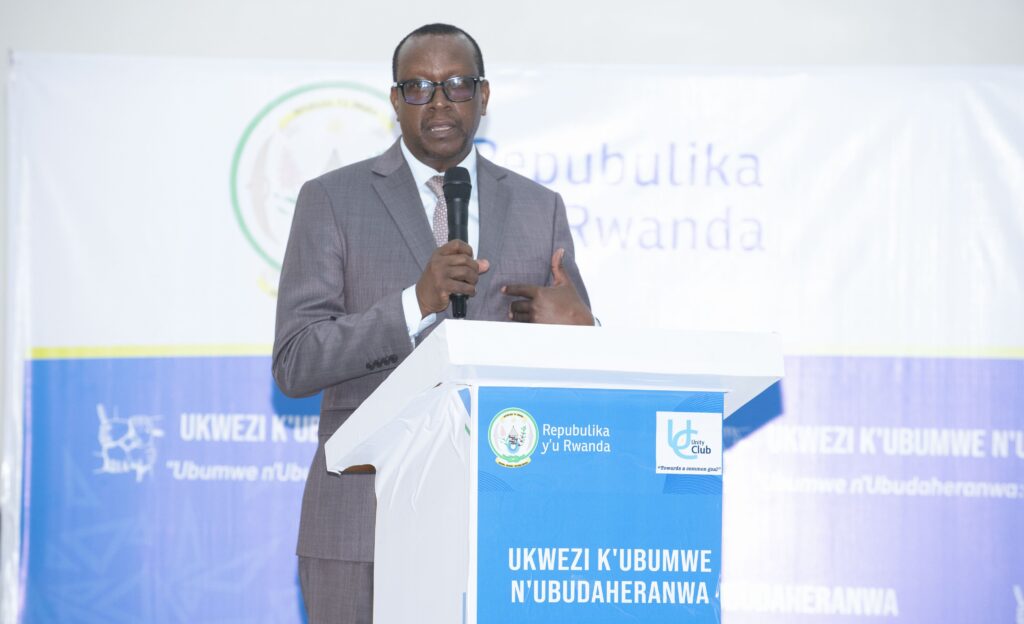
The 1994 Genocide against the Tutsi was the devastating outcome of decades of ethnic division promoted by political parties, including PARMEHUTU, APROSOMA, MRND and CDR, Minister of National Unity and Civic Engagement Dr Jean Damascène Bizimana has said.
Bizimana made the remarks on October 13, 2026, during a unity and resilience forum bringing together participants from Huye, Nyanza and Gisagara districts at the University of Rwanda’s Huye campus.
He said divisive politics spread among Rwandans between 1959 and 1994, creating conditions that ultimately led to the Genocide against the Tutsi.
The minister identified the three districts as areas where ethnic division gained ground in 1959. He recalled that Grégoire Kayibanda announced the formation of PARMEHUTU on September 25, 1959.
Bizimana also recounted how Kayibanda met Joseph Habyarimana Gitera at Hôtel Faucon before attending an APROSOMA rally in Ngoma, where he announced what became known as the “Ten Commandments of the Hutu”.
He said Rwanda had made significant progress in rebuilding national unity since the Genocide was stopped in 1994, with the country’s unity and resilience score reaching 95.3%.
“We must continually examine the dark situation from which the RPF-Inkotanyi rescued Rwanda and how it transformed into a country belonging to all Rwandans, rather than the Rwanda for Gahutu that PARMEHUTU, APROSOMA, MRND, CDR and the entire Hutu Power movement advocated,” he said.
“We must understand what destroyed Rwanda and remain vigilant to prevent it from happening again, so that no one dares to dream of destroying the country while others watch or turn a blind eye.”
He urged Rwandans to continue protecting the country’s achievements and strengthening unity to prevent a recurrence of the divisions that preceded the genocide.
Bizimana also highlighted figures on genocide convictions in the three districts, saying Huye had the highest number of people convicted by Gacaca courts for their involvement in the Genocide against the Tutsi, at 81,126. Nyanza ranked second with 68,566, while Gisagara ranked third with 63,200.
However, the ministry’s 2025 study on unity and resilience placed Nyanza fourth nationally, while Gisagara ranked 26th and Huye 28th.
The discussions were held as Rwanda marks its month of unity and resilience, which coincides with the anniversary of October 1, 1990, when the RPF-Inkotanyi launched the four-year liberation struggle.