Rwanda has secured a 10-year agreement to host Formula 1 races, following an agreement with the Fédération Internationale de l’Automobile (FIA), the international governing body for motorsport, to bring one of the world’s premier racing competitions to the country.
The announcement sparked debate among people who doubted that Rwanda, which has never hosted a Formula 1 race, could beat countries such as Morocco and South Africa, both of which have hosted the competition in the past. It also raised questions about the criteria Formula 1 uses to select new host countries.
The announcement that Rwanda would host Formula 1 from 2030 drew attention to the country’s efforts to bring the competition back to Africa, particularly because South Africa had also been campaigning for its return.
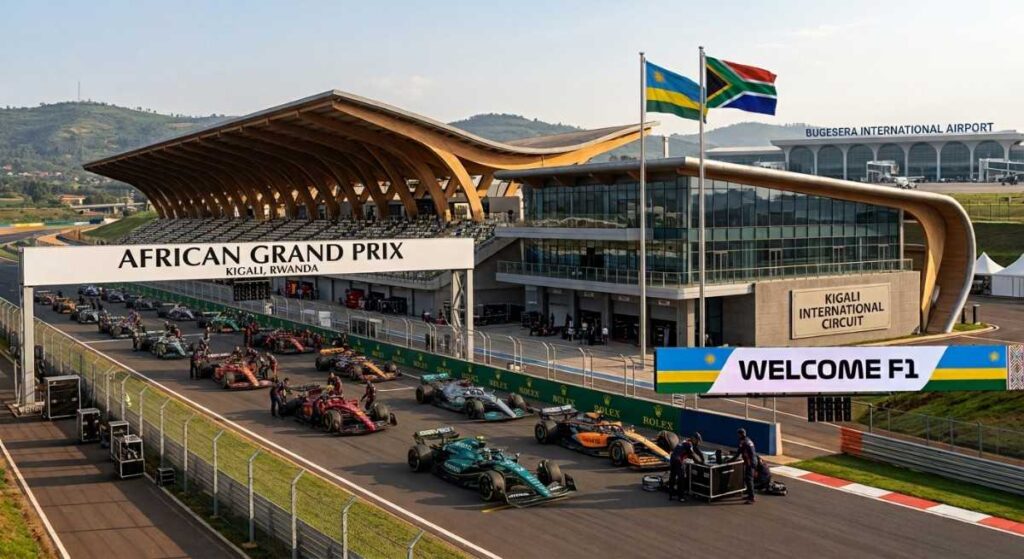
On October 13, 2026, Formula 1 announced a 10-year agreement with Rwanda to host a race in Bugesera District, near the site of the new Kigali International Airport under construction.
The event would be the first Formula 1 race held in Africa since 1993, when South Africa hosted the final race on the continent at the Kyalami circuit near Johannesburg.
This has prompted questions about whether Rwanda genuinely defeated South Africa in the competition to host the race, although detailed information comparing the two countries’ negotiations with Formula 1 has not been made public.
What is Rwanda’s strategy?
One of the most striking aspects of Rwanda’s proposal is its plan to build a new circuit in Bugesera, while South Africa already has the historic Kyalami circuit, which has a long association with motorsport.
This demonstrates that having an existing circuit is not, by itself, enough to secure the right to host a Formula 1 race.
An analysis published by Motor Sport Magazine on October 13, 2026, highlighted differences between Rwanda’s proposal and South Africa’s longstanding efforts to bring Formula 1 back to the country.
Rwanda has prioritised a new circuit in Bugesera as part of a broader investment plan involving tourism, infrastructure and business development.
South Africa, meanwhile, has pursued the return of Formula 1 using Kyalami or by considering other locations where the necessary infrastructure could be developed.
Although these differences help explain the contrasting approaches, Formula 1 has not published scores or detailed criteria showing how the two proposals were assessed against each other.
What does Formula 1 consider when choosing a host?
In an interview with Autosport in April 2025, Formula 1 chief executive Stefano Domenicali said bringing the competition back to Africa would require a prospective host to demonstrate its commitment to investment, infrastructure and the long-term organisation of the event.
When the agreement for Rwanda to host Formula 1 was announced, FIA president Mohammed Ben Sulayem, Formula 1 chief executive Stefano Domenicali and President Paul Kagame presented the project as more than an opportunity to stage a race. They said it could also help develop tourism, business, technical skills and African participation in motorsport.
Several key factors influence the selection of a new Formula 1 venue.
Financial agreements and economic capacity
Formula 1 negotiates with investors and organisations responsible for staging races to establish funding arrangements and agree on how events will be delivered over the contract period.
Hosting a Formula 1 race requires substantial investment in circuit construction or upgrades, security, event operations and facilities capable of accommodating large numbers of visitors.
A prospective host must demonstrate that it can support the project financially over the long term.
A circuit that meets technical requirements
The FIA establishes the technical and safety standards required for circuits hosting Formula 1 races.
A circuit must meet the relevant Grade 1 requirements, covering safety, track design and other technical specifications necessary for modern racing cars.
Securing an agreement to host a race does not automatically mean that a circuit which has yet to be completed has already received FIA approval. Rwanda must finish developing its Bugesera circuit and ensure that it meets the required standards.
The planned circuit will be located in Bugesera District, approximately 40 kilometres from Kigali. It is expected to be designed by former Formula 1 driver Alex Wurz in collaboration with circuit engineering firm Hermann Tilke.
The venue is expected to accommodate up to 100,000 spectators.
Plans indicate that the circuit will be six kilometres long, with 17 corners.
It will feature long straights where cars can reach high speeds, alongside technical sections requiring drivers to slow down and navigate corners carefully.
Adequate infrastructure
Formula 1 attracts people from around the world, including drivers, teams, journalists, sponsors and fans.
A host country must have sufficient infrastructure, including roads, airports, hotels, security services and other facilities needed to accommodate international visitors.
In his interview with Autosport, Domenicali emphasised that hosting Formula 1 involves more than building a racing circuit. A country must also have the wider infrastructure needed to welcome visitors and benefit economically from the event.
A sustainable long-term project
Formula 1 considers whether a proposed race can be sustained financially and operationally, while delivering lasting benefits to the host country.
Rwanda plans to use the Bugesera circuit for other activities, including entertainment events and conferences, rather than limiting it to Formula 1 races.
Jean Guy Afrika, chief executive of the Rwanda Development Board (RDB), said hosting Formula 1 forms part of a long-term strategy to position Rwanda as a hub for tourism, investment and services.
A place on the Formula 1 calendar
Even if a country has a circuit that meets the required standards and sufficient funding, that does not guarantee it a place on the Formula 1 calendar.
Organisers must negotiate the necessary agreements and coordinate the proposed event with other Grand Prix races held around the world.
Hosting Formula 1 therefore requires cooperation between the host country, investors, race organisers and the governing bodies responsible for the sport.
Why hasn’t South Africa’s Kyalami circuit secured a race?
South Africa has a rich Formula 1 history. The Kyalami circuit hosted the competition on several occasions, most recently in 1993.
However, having a circuit with a Formula 1 history does not automatically qualify a country to host another race.
The circuit must meet current requirements, while the country must demonstrate its ability to finance the event, provide supporting infrastructure and organise the race successfully.
South Africa has explored ways to bring Formula 1 back, including proposals involving Kyalami and other possible venues. However, no new agreement for the country to host a race had been publicly announced at the time of reporting.
Does South Africa still hope to host Formula 1?
On October 15, 2026, South African media reported that Sports Minister Gayton McKenzie had congratulated Rwanda on securing the agreement, while insisting that South Africa had not been defeated in its broader efforts to bring Formula 1 back.
McKenzie said Africa was still exploring the possibility of hosting a race in 2028 or 2029. However, his remarks have prompted questions about whether they reflected a concrete plan or an expression of ambition, as no agreement confirming a South African race in either year had been publicly announced.
Although some countries host multiple Formula 1 races, adding another event to the calendar requires new negotiations, contractual agreements and sufficient space in an already crowded schedule.
Following its agreement, Rwanda began advancing plans for the Bugesera circuit and the supporting infrastructure needed to host the race.
The exact date of Rwanda’s first Formula 1 Grand Prix has not yet been announced in detail. However, the event cannot take place until the circuit is completed and approved by the FIA to host Formula 1 racing.