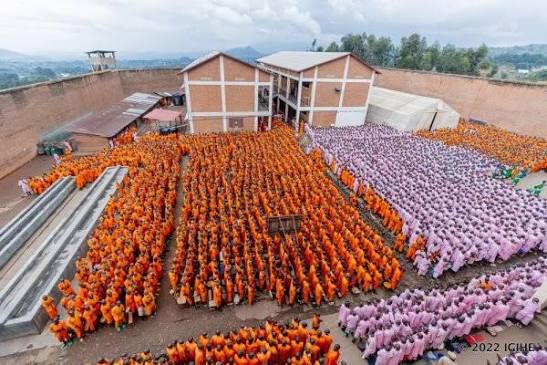
Rwanda’s Ministry of Justice says guilty pleas and agreements between offenders and victims have helped reduce prison overcrowding over the past 15 years, with occupancy levels falling from 144.5% to 97.5%.
Minister of Justice and Attorney General Dr Emmanuel Ugirashebuja said the measures continue to deliver results, adding that the government will strengthen efforts to resolve minor disputes through mutual agreement rather than referring every case to court.
“Just before the restorative justice policy was introduced, prison overcrowding had reached 144.5%. After its implementation began, the level gradually declined and now stands at 97.5%,” he said.
Prison overcrowding increased sharply following the 1994 Genocide against the Tutsi, when large numbers of people were detained on suspicion of, or convicted of, genocide-related crimes.
In 2010, a report by a UK-based research organisation specialising in crime prevention policies and strategies ranked Rwanda first among 10 African countries with the highest prison populations relative to their populations. At the time, 547 people per 100,000 residents were in prison.
The National Commission for Human Rights’ 2024/2025 report on human rights in Rwanda’s prisons found that 74,253 people were being held in 14 correctional facilities designed to accommodate 67,431 inmates, representing an overcrowding rate of 110%.
Of those inmates, 58,084, or 78.2%, were serving sentences for ordinary crimes, while 16,169, equivalent to 21.8%, were imprisoned for genocide-related crimes.
Figures from the Ministry of Interior show that prison occupancy had fallen to 97.2% by March 2026.
The continued decline in prison numbers was also reflected in the closure of Bugesera Prison after its inmate population fell by nearly half, allowing the remaining prisoners to be transferred to other correctional facilities.
Guilty pleas and settlements continue to reduce overcrowding
Between the 2022/2023 and 2025/2026 judicial years, a total of 36,227 cases were resolved through guilty pleas in exchange for reduced sentences, while another 1,857 were settled through agreements between offenders and victims.
Rwanda’s courts spokesperson, Harrison Mutabazi, said restorative justice procedures in the courts began being implemented 10 months ago and had already produced significant results.
He said the target was to resolve 4,000 cases through the policy by the end of the judicial year.
Overall, by June 2026, a total of 38,084 cases had been resolved without following the conventional court trial process.
The policy aims to improve access to justice, reduce the time and money spent on legal proceedings and resolve disputes more quickly while respecting the law and the rights of the parties involved.