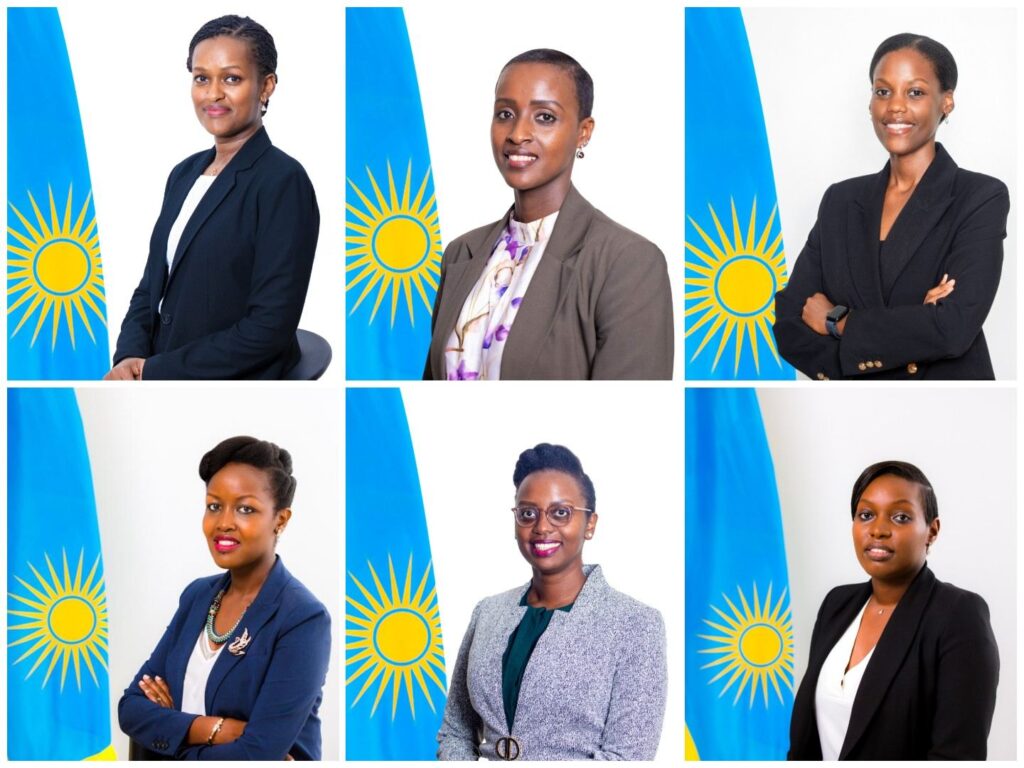
Rwanda is among the countries with high levels of female representation in public institutions, with women playing a significant role in national decision-making.
Women’s participation in leadership is enshrined in Rwanda’s Constitution, which requires women to hold at least 30% of positions in decision-making institutions.
As of October 8, 2026, women account for 38% of Rwanda’s Cabinet, including six women who head ministries.
The Cabinet has 36 members: the Prime Minister, 20 ministers, 12 ministers of state, including six women, as well as the chief executives of the Rwanda Development Board (RDB) and Rwanda Governance Board (RGB), whose positions are at ministerial level.
Here are the women serving in the Cabinet, their responsibilities and some key facts about their careers, with particular focus on the six female ministers.
1. Ines Mpambara
Ines Mpambara has been a Minister in the Office of the Prime Minister since February 2020. She is responsible for ensuring that Cabinet business is conducted effectively and transparently, and that adequate consultation takes place before policy decisions are made.
Before taking up the position, Mpambara had spent more than 10 years working in the Office of the President, starting in 2011. She also worked at the Ministry of Health, where she headed the Rwanda Health Communication Centre. She was also head of the School of Journalism and Communication at the University of Rwanda.
In 2024, she received an award from the Sharjah government in the United Arab Emirates for her contribution to improving communication between government institutions and citizens.
2. Nelly Mukazayire
Nelly Mukazayire has been Rwanda’s Minister of Sports since December 2024, when she replaced Richard Nyirishema. She had served as the ministry’s permanent secretary for three months before becoming minister.
Before joining the Ministry of Sports, Mukazayire was Deputy Chief Executive Officer of the Rwanda Development Board, where she focused mainly on tourism, exports and investment.
She also served as Chief Executive Officer of the Rwanda Convention Bureau and spent 10 years as Deputy Director General in the Office of the President.
Mukazayire holds a master’s degree in Economic Policy Management from Makerere University.
3. Ingabire Musoni Paula
Ingabire Musoni Paula has been Minister of ICT and Innovation since October 2018.
She attended Lycée de Kigali, where she studied mathematics and physics, before joining the former Kigali Institute of Science and Technology (KIST), now part of the University of Rwanda’s College of Science and Technology.
She studied computer science at KIST and later pursued a master’s degree at the Massachusetts Institute of Technology in the United States, graduating in July 2018.
Ingabire previously worked at the Rwanda Information Technology Authority (RITA), where she was responsible for private-sector engagement in technology. She later became a project manager.
RITA was subsequently transferred to the Rwanda Development Board, where she served in several roles, including head of the technology department.
In 2020, Ingabire was named among young leaders to watch by the World Economic Forum.
4. Dr Bernadette Arakwiye
Dr Bernadette Arakwiye has been Rwanda’s Minister of Environment since July 24, 2025, when she was appointed by President Paul Kagame.
She is an environmental expert and researcher specialising in forest and land restoration, as well as remote sensing and geographic information systems (GIS).
She holds a PhD in Earth sciences from a university in the United States and a master’s degree in environmental sciences from a university in the United Kingdom.
Before becoming minister, Arakwiye held senior positions at international organisations. She worked at the World Resources Institute (WRI), where she was Senior Manager for Africa Restoration Programmes.
She also worked as an ecosystem services data analyst in the United States.
5. Judith Uwizeye
Judith Uwizeye has been Minister of Public Service and Labour since June 10, 2026. She returned to the ministry after previously serving as its minister between 2014 and 2017. She also served as a minister in the Office of the President.
She holds a master’s degree in International Economic and Business Law from the University of Groningen in the Netherlands.
Uwizeye previously worked as a lecturer in private law at the former National University of Rwanda.
6. Uwimana Consolee
Uwimana Consolee has been Minister of Gender and Family Promotion since June 2024.
Among her previous roles, she served as First Vice President of the RPF-Inkotanyi, becoming the first woman to hold the position in the party’s history.
She was also a member of the Senate from 2012 to 2020.
During her time in the Senate, Uwimana held several positions, including First Vice Chairperson of the Standing Committee on Economic Development and Finance.
She also served as Secretary General of the Rwanda Women Parliamentary Forum (FFRP) and Vice President of the African Parliamentary Group on Prevention and Combating Genocide (AGPF).
She represented Rwanda’s chapter of the African Parliamentarians Network Against Corruption (APNAC) at national, regional and continental levels.
Before joining the Senate, she worked in several financial institutions, including BACAR and BPR, where she held various positions.
Six of the 12 ministers of state are women
In addition to the six female ministers, six women serve as ministers of state in different ministries.
They include Irere Claudette, Minister of State at the Ministry of Education; Dr Usta Kaitesi, Minister of State at the Ministry of Foreign Affairs; and Sandrine Umutoni, Minister of State at the Ministry of Youth and Arts Development.
Others are Kayisire Marie Solange, Minister of State at the Ministry of Local Government; Mutesi Linda Rusagara, Minister of State at the Ministry of Finance and Economic Planning, responsible for revenue mobilisation and public investment; and Dr Solange Uwituze, Minister of State at the Ministry of Agriculture and Animal Resources.
Other women in senior government positions include Dr Doris Picard Uwicyeza, Chief Executive Officer of the Rwanda Governance Board, and Juliana Muganza, Deputy Chief Executive Officer of the Rwanda Development Board.
Women’s representation in the Cabinet and other decision-making institutions reflects Rwanda’s progress in promoting gender equality and increasing women’s participation in governance.
Women account for 63.75% of members of the Chamber of Deputies and 46.2% of the Senate.
However, despite progress in political leadership, labour market figures show that gaps in economic opportunities remain.
In the second quarter of 2026, the employment-to-working-age population ratio was 46.6% for women, compared with 61.8% for men. The unemployment rate stood at 15.5% among women, compared with 11.6% among men.