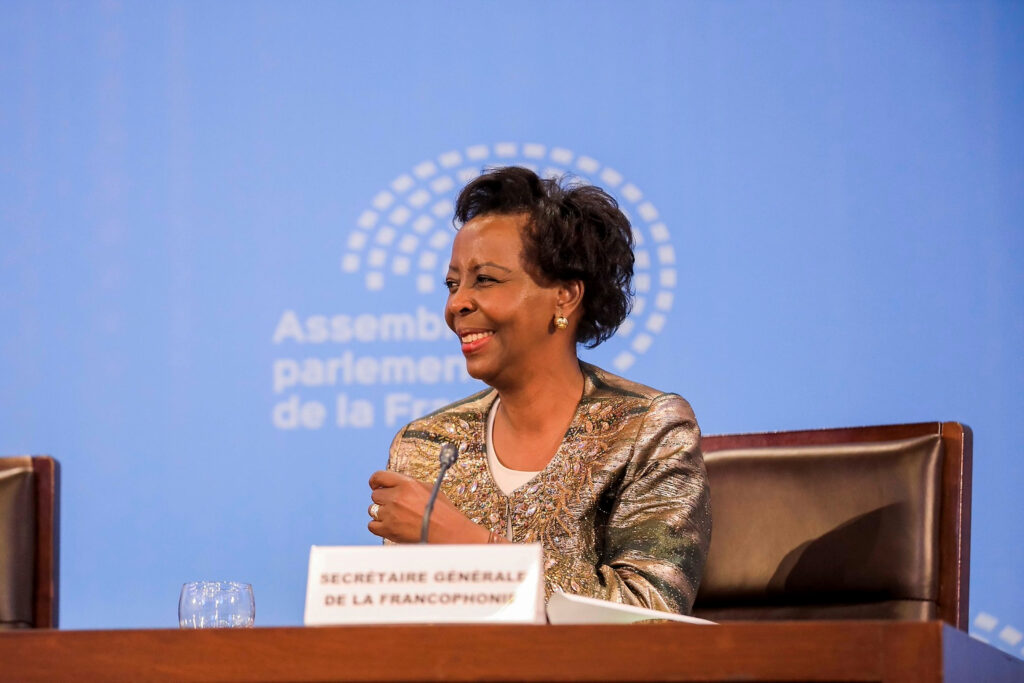
Louise Mushikiwabo has led the International Organisation of La Francophonie (OIF) for seven years, with her tenure focused on women’s empowerment, youth, technology, education and strengthening ties among French-speaking countries and communities.
Mushikiwabo served as Rwanda’s Minister of Foreign Affairs from 2009 to 2018 before being elected OIF Secretary-General in 2018 in Yerevan. She became the first African woman to hold the position and was re-elected for a second term in 2022 at the Francophonie Summit in Djerba, Tunisia.
During her tenure, OIF says it has mobilised and spent €336 million on various initiatives, with 97% of the budget allocated to its programmes implemented.
Her administration has also emphasised transparency and accountability, with key organisational documents made publicly available and the organisation’s finances subjected to annual independent audits.
Women at the centre
One of the major initiatives launched during Mushikiwabo’s tenure is La Francophonie avec Elles, introduced in 2020 as the world grappled with the effects of the COVID-19 pandemic.
The programme has supported 354 projects in 36 countries and helped nearly 100,000 women improve their livelihoods. Published figures show that the incomes of women benefiting from the projects increased by nearly three times.
Mushikiwabo has argued that investing in women is an investment in broader development, as educating girls and empowering women to start businesses can contribute to improved livelihoods for families and communities.
Youth and technology
Youth and digital skills have also been key areas of focus during her tenure.
Through La Francophonie de l’avenir, more than 10,000 young people from 134 countries contributed ideas on the future direction of the organisation.
The D-CLIC programme aims to provide 100,000 young people with digital skills, while CAP Innovation supports young entrepreneurs in French-speaking countries as they develop new ventures.
Mushikiwabo has also placed artificial intelligence on the organisation’s agenda, arguing that Africa should participate in shaping the rules and standards governing AI rather than simply using the technology.
Promoting education in local languages
In education, OIF continues to implement the ELAN programme, which helps children begin reading and writing in their mother tongues before transitioning to French and other languages.
The programme has reached more than 12 million learners, uses 46 African languages and has contributed to the training of about 230,000 teachers.
Mushikiwabo has maintained that a strong foundation in a child’s mother tongue can improve their ability to learn additional languages and academic subjects.
Strengthening links across Africa
Mushikiwabo has also highlighted the need for greater interaction and cooperation among Africans, particularly in trade, education, culture and technology.
She has argued that Africa’s common market offers significant opportunities, but that limited trust and insufficient interaction among Africans remain obstacles to fully realising those opportunities.
She sees OIF as having an important role in bringing French-speaking countries and their populations closer together while facilitating the exchange of knowledge and opportunities.
The programmes and figures recorded during her seven years at the helm of OIF provide an overview of the organisation’s priorities during her tenure, particularly its focus on women, youth, education, technology and cooperation.
Mushikiwabo’s tenure has also coincided with the growing importance of Africa within the Francophonie. She has emphasised that by 2050, the majority of the world’s French-speaking population is expected to be in Africa.
The November 2026 election will see Mushikiwabo face Juliana Amato Lumumba of the Democratic Republic of Congo, Mauritania’s Coumba Ba and Dacian Cioloș, a former prime minister of Romania.
The election will determine who leads the organisation as it seeks to strengthen cooperation among its 90 member states and governments and serve a French-speaking population estimated at about 396 million worldwide.