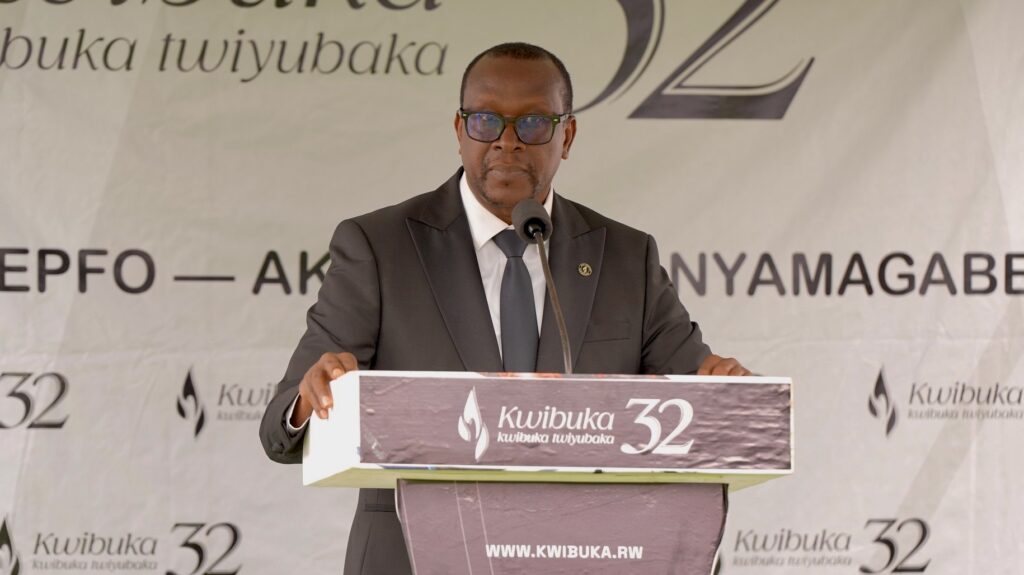
The Minister of National Unity and Civic Engagement, Dr. Jean Damascene Bizimana, has said that the former Gikongoro Prefecture was among the areas where the Genocide against the Tutsi was carried out with extreme intensity, noting that Nyamagabe District ranks second nationwide in terms of families that were completely exterminated.
He made the remarks on Saturday while joining residents of Nyamagabe District in Kaduha Sector for the 32nd commemoration of the Genocide against the Tutsi.
Citing research conducted by GAERG, Bizimana said Nyamagabe ranks second in the country in terms of families that were entirely wiped out during the genocide, with 1,535 families comprising 5,790 people killed.
He said Karongi District ranks first, while Nyaruguru District, also part of the former Gikongoro region, ranks sixth, with 804 families totaling 3,589 people exterminated.
Bizimana noted that in the former Gikongoro Prefecture, killings began as early as April 7, 1994, stressing that victims were targeted indiscriminately, driven by extremist ideology rather than personal ties or direct involvement in political events of the time.
He cited massacres in areas including Mushubi, Mata, and Ruramba, saying perpetrators acted out of long-standing hatred and indoctrination rooted in ethnic extremism.
He further pointed to Nyamagabe as one of the districts where mass killings were concentrated in single-day massacres, highlighting that more than 45,000 Tutsi were killed in Kaduha on April 21, 1994, over 50,000 in Murambi, and more than 35,000 in Cyanika.
According to him, by mid-April 1994, Tutsi populations in several parts of Nyaruguru had already been exterminated, including in places such as Muganza parish, Kibeho, Nteko, Musebeya, and Cyahinda, in killings he said were organized and executed systematically.
Bizimana also strongly dismissed genocide denial narratives, stressing that international judicial rulings have consistently confirmed that the Genocide against the Tutsi was a planned and executed crime.
He referenced the International Criminal Tribunal for Rwanda (ICTR), particularly the 1998 Akayesu judgment, which established that genocide occurred in Rwanda targeting Tutsi because of their identity.
He further cited the 2006 ruling in the Karemera, Nzirorera, and Ngirumpatse case, which confirmed that the genocide against the Tutsi is an established international legal fact that is not subject to dispute.
He welcomed recent statements from the United States reaffirming solidarity with Rwanda and explicitly recognizing the Genocide against the Tutsi in its official messaging.
Bizimana called on Rwandans to preserve the history of the genocide, draw lessons from its causes and consequences, and strengthen values of unity, good governance, and national cohesion.
The commemoration ceremony in Kaduha concluded with the dignified burial of the remains of three victims of the Genocide against the Tutsi that had recently been recovered.